
26% of affairs start at the school gate, new data reveals

The key findings

* More than a quarter of affairs begin through school connections, new research shows
* Parents of children in Years 3 and 4 are most at risk, according to the data
* PTA meetings, sports days and class WhatsApp groups are the most common affair flashpoints
* Study conducted by IllicitEncounters.com, the UK’s largest extramarital dating site

It’s the place you drop off your kids every morning. But according to new research, the school gate is also one of Britain’s most fertile grounds for extramarital affairs.

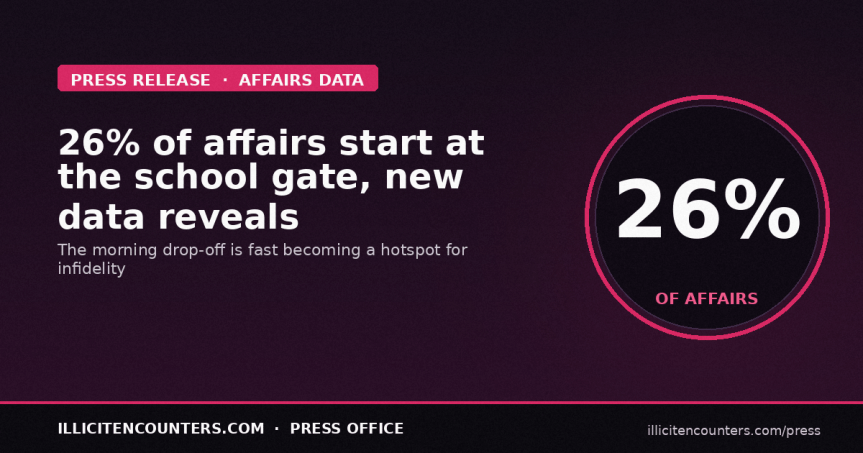
A poll of 2,200 parents by IllicitEncounters.com, the UK’s leading married dating site, has revealed that 26% of affairs begin through school connections – making it one of the most common places a marriage starts to unravel.

And the danger zone? Parents of children in Years 3 and 4 are the most likely to stray, accounting for 21% of school-gate affairs. Years 1 and 2 parents follow closely at 19%, with Years 5 and 6 at 18%. Reception parents account for 16%, secondary school parents for 15%, and sixth form parents make up the remaining 11%.

As for where these connections are made, PTA meetings top the list at 31%, followed by class WhatsApp groups at 27% – proving that the group chat intended for reading lists and bake sale reminders could be doing more harm than good in relationships.

Sports days accounted for 19% of initial encounters, while the daily school pick-up and drop-off itself is responsible for 13%. School social events such as discos, fairs and fundraisers account for the remaining 7%.

Perhaps most striking of all is the speed at which these connections escalate. On average, it takes just 4.7 months from first meeting to full-blown affair – suggesting that regular contact, shared parenting experiences, and underlying marital dissatisfaction make for a potent combination.

One woman who took part in the poll, a mother of two from the South East, says her affair began ​​innocently in a Whatsapp group, “We were both in the Year 3 group, and he messaged me privately to ask if my son had brought home the wrong jumper. We started joking about how stressful the homework was, and within a month, those jokes turned into late-night chats.

The school run became the highlight of my day. We’d catch each other’s eye across the playground – it felt like we had this huge secret in plain sight. It’s the perfect cover, your spouse never suspects you’re cheating when you say you’re just staying late for a PTA meeting.”

Expert comment from Jessica Leoni

Jessica Leoni, sex and relationships expert at IllicitEncounters.com, says the findings are unsurprising. “The school gate is a goldmine for connection – you see the same people every single day, you have an instant shared bond in your children, and you’re often at a stage of life where your marriage has settled into routine. Add a flirty WhatsApp group into the mix and it’s a recipe for something more.”

Leoni says the research highlights how everyday routines can unexpectedly create opportunities for relationships to form. “Affairs rarely begin in dramatic circumstances,” she says. “More often they start with ordinary conversations that slowly become more personal over time.”

Results

At what point in your children’s school life did your affair start?

Reception – 16%
Years 1 to 2 – 19%
Years 3 to 4 – 21%
Years 5 to 6 – 18%
Secondary school – 15%
Sixth Form/College – 11%

How did the affair begin?

PTA meetings – 31%
Class WhatsApp groups – 27%
Sports day – 19%
School pick-up/drop-off – 13%
School social events – 7%
Other – 3%

Further Reading

For more on this topic, explore affair dating on Illicit Encounters.

“He preferred me bigger”: Wife says weight loss jab destroyed her marriage and forced her to stray

The key findings

* 44% of women say losing weight boosted their confidence – but many say it damaged their relationship.
* Over a third report their partner became less affectionate after they slimmed down.
* One woman, 42, says her three‑stone “glow up” left her husband distant – and pushed her towards an affair.
* Study conducted by IllicitEncounters.com, the UK’s largest extramarital dating site.

Weight loss is supposed to transform your life for the better. But, for one woman, shedding three stone didn’t just change her body – it changed her marriage.

A new poll conducted by IllicitEncounters.com, the UK’s largest extramarital dating site, involving 2,000 women has revealed that while slimming down often boosts confidence, it can also create unexpected tension at home – with 52% saying changes in their weight had a negative impact on their relationship.

According to the data, 44% of women said their confidence increased after losing weight. But the emotional ripple effects weren’t always positive.

More than a third (37%) said their partner became less affectionate after their weight loss, while 34% noticed increased jealousy following their “glow up”.

Meanwhile, 29% of women who slimmed down felt their partner seemed “intimidated” by their new confidence.

For one 42-year-old mother-of-two, who asked to remain anonymous, the change was stark. After losing three stone using Mounjaro, she says she has never felt better in herself – but her husband’s reaction left her blindsided.

“I’ve never felt more attractive in my life,” she says. “For years I struggled with my weight. I didn’t feel confident getting dressed up or initiating intimacy. Losing the weight made me feel like me again.”

But instead of reigniting the spark at home, she says the dynamic shifted. “He used to grab me constantly. Now he barely looks,” she explains. “At first I thought I was imagining it. But the more confident I became, the more distant he seemed.”

She says her husband even admitted he preferred her before the weight loss. “He says he ‘misses my curves’, but I think he misses feeling more secure. When I was bigger, I don’t think he ever worried about other men noticing me.”

As her confidence grew, she began receiving more attention – something she says her husband struggled with. “There were little comments. If I dressed up, he’d ask who I was trying to impress. If I went out with friends, he’d act cold afterwards.”

Eventually, she says the emotional distance pushed her elsewhere.“I thought losing weight would improve everything. I didn’t expect it to threaten my marriage,” she admits. “So, when my husband didn’t appreciate the way I’d become, I decided perhaps it was time to find someone who did – and I’ve been having an affair for the past two months as a result.”

Expert comment from Jessica Leoni

Sex and relationship expert at IllicitEncounters.com, Jessica Leoni, says the findings reflect a power shift that can occur when one partner undergoes a visible transformation. “Weight loss can dramatically alter relationship dynamics,” she explains. “If one partner’s confidence increases significantly, it can unsettle the balance that existed before.”

She adds that insecurity can manifest in subtle but damaging ways. “For some partners, especially if the relationship was built around a certain dynamic, a physical ‘glow up’ can trigger feelings of inadequacy or fear of abandonment. Instead of celebrating the change, they may withdraw or become jealous.”

Leoni says it’s not uncommon for increased external attention to amplify tensions. “When one partner starts receiving more validation from outside the relationship, it can highlight cracks that were already there,” she says. “If communication isn’t strong, resentment can build quickly.”

Further Reading

For more on this topic, explore married dating on Illicit Encounters.
People trust AI more than their partner with their deepest secrets, poll reveals

The key findings

* More than a third of people now trust AI with personal secrets over their own partner, with many saying it feels less judgemental and emotionally safer.
* Brits are confiding in AI about relationship doubts, sexual fantasies, thoughts of cheating and even past affairs – conversations they avoid having at home.
* Experts warn that while AI offers a consequence‑free space to open up, relying on it instead of honest communication could deepen cracks in real‑world relationships.
* Study conducted by IllicitEncounters.com, the UK’s largest extramarital dating site.

Brits are now more likely to confide in artificial intelligence than the person they share a bed with. And, it seems the biggest threat to communication in relationships might not be another person – but a robot.

A new poll of 1,800 members of IllicitEncounters.com, the UK’s largest extramarital dating site, has revealed that more than a third (38%) would rather share a personal secret with AI than open up to their partner.

In fact, 27% admit they’ve already told an AI chatbot something deeply personal that they have never confessed to their other half.

And it’s not just convenience driving the trend. One in five (21%) say they feel “less judged” by AI than they do by their partner – suggesting that for some, a machine feels safer than a marriage.

So what exactly are people telling these bots? The most common confession involves relationship doubts, with 44% admitting they’ve turned to AI to vent about concerns regarding their partner instead of addressing the issue directly at home.

More than a third (36%) say they’ve used AI to discuss their sexual fantasies – conversations they felt uncomfortable initiating with their partner.

Meanwhile, 31% have confided in AI about thoughts of cheating, and 22% say they’ve opened up about regrets over past affairs rather than revisiting those conversations with the person they’re with.

One married mother-of-two from Surrey, who asked to remain anonymous, says she turned to AI after struggling to open up to her husband of 15 years. “I love my husband, but I couldn’t bring myself to tell him I’d been having doubts about our future. Every time I tried, I’d see his face fall and I’d bottle it. So I typed it into ChatGPT instead. It felt ridiculous at first – pouring my heart out to a robot. But it didn’t interrupt, didn’t get defensive, didn’t look hurt. It just… listened. I know it’s not real, but it was just good to talk about my feelings openly.”

Expert comment from Jessica Leoni

Jessica Leoni, sex and relationships expert at IllicitEncounters.com, says the results reflect a growing emotional shift. “AI doesn’t roll its eyes, raise its voice or bring up something you said three years ago,” she said. “For many people, that makes it feel like a safer space to explore uncomfortable thoughts.”

She believes the appeal lies in the absence of consequence. “When you confess something to your partner, it can change the dynamic of the relationship. There are emotional repercussions. With AI, there’s no fallout. No hurt feelings. No awkward silence.”

But Leoni warns that relying on technology instead of communication could deepen existing cracks. “Using AI as a sounding board isn’t necessarily harmful,” she explained. “In fact, it can sometimes help people organise their thoughts. The problem comes when it replaces honest dialogue rather than preparing you for it.”

She adds that the types of secrets people are sharing are particularly telling. “Relationship doubts, sexual fantasies, thoughts about cheating – these are exactly the conversations that could save a relationship if handled well. But people are too scared to have them. They’d rather test the waters with a robot than risk real vulnerability with a human. And that’s a tragedy.”

Results
What have you confided in AI about rather than speaking with your partner?

Relationship doubts – 44%
Sexual fantasies – 36%
Thoughts about cheating – 31%
Regrets about past affairs – 22%
General relationship advice – 20%
Other – 8%

Further Reading

For more on this topic, explore discreet dating on Illicit Encounters.

Brits split over what REALLY counts as cheating – and there’s no going back if you do this one thing

The key findings

* New research reveals Brits are far more forgiving of digital slip‑ups than physical or emotional betrayals.

* Liking photos and harmless crushes top the list, while emotional affairs rank as the hardest to excuse.

* Experts say the findings show how modern couples draw very different lines between impulsive mistakes and deeper breaches of trust.

* Study conducted by IllicitEncounters.com, the UK’s largest extramarital dating site

New research has revealed the nation’s surprisingly forgiving hierarchy when it comes to infidelity – and it turns out not all cheating is created equal.

The poll of 2,000 Brits conducted by IllicitEncounters.com, the UK’s largest extramarital dating site, asked respondents to choose the single most forgivable form of cheating from a list of seven common betrayals. 

At the softer end of the scale, liking photos on social media emerged as the most forgivable behaviour, with 29% of people saying they could let it slide. 

18% said they could forgive their partner for having a crush on a work colleague, suggesting that fleeting feelings are seen as human – as long as they don’t turn into action.

Things became murkier when digital behaviour turned more intimate. Flirty texting with an ex was considered forgivable by 15%, while having a dating app profile – even without meeting anyone – was acceptable to 14% of respondents. 

Physical cheating proved harder to excuse. Kissing someone else was seen as forgivable by 11%, but only 9% said they could move past a one‑night stand or sex with someone else. 

The least forgivable act of all was an emotional affair, with only 4% saying they’d be able to look past it.

Sex and relationship expert at IllicitEncounters.com, Jessica Leoni, believes the findings highlight how differently people define betrayal. “Cheating isn’t a one-size-fits-all concept anymore,” she said. “For some couples, liking a photo is meaningless. For others, it’s the start of a slippery slope. What this research shows is that people draw their red lines in very different places.”

Expert comment from Jessica Leoni

She added that emotional infidelity can sometimes cut deeper than physical acts.“Many people see sex as a moment of weakness, particularly if alcohol or circumstance is involved,” Jessica explained. “But emotional affairs require time, secrecy and sustained investment. That’s often why they feel more threatening – they suggest a partner’s attention and affection are being redirected.”

One 34-year-old woman from Manchester, who asked not to be named, said she chose to forgive her husband after he admitted to a drunken one-night stand.

“It was devastating at first,” she said. “But when we talked it through, I realised it hadn’t been about feelings – it was a stupid decision in a single moment. What would have hurt more is if he’d been confiding in someone else for months behind my back.”

Leoni added that forgiveness often depends on context. “People are more likely to forgive something they can rationalise,” she said. “If it feels impulsive, they may see it as salvageable. But if it feels calculated or emotionally invested, it can be harder to come back from.”

Results

Which of these do you consider the most forgivable?

  • Liking photos on social media 29%
  • Having a crush on a work colleague 18%
  • Flirty texting with an ex 15%
  • Having a dating app profile 14%
  • Kissing someone else 11%
  • Sex with someone else 9%
  • An emotional affair 4%

Further Reading

For more on this topic, explore affair dating on Illicit Encounters.

Red Tuesday: Why tomorrow is the most popular day of the year to get dumped

The key findings

* Nearly half of Valentine’s break-ups happen on ‘Red Tuesday’, with 49% choosing the day to end things before romance (and spending) kicks in.

* Money, guilt and emotional burnout are driving the split, as 41% dump partners to avoid Valentine’s costs and 38% admit they’re tired of faking affection.

* Most break-ups aren’t impulsive – over 80% had been planning it for days or longer, with after-work dumps the most common timing.

* Study conducted by IllicitEncounters.com, the UK’s largest extramarital dating site

Tomorrow marks Red Tuesday – the day Brits are statistically most likely to call time on their relationship as Valentine’s Day looms.

New research from IllicitEncounters.com, the UK’s largest extramarital dating site, reveals that the Tuesday before Valentine’s Day (10th February) is the single most popular day of the year to get dumped, as thousands of Brits perform a last-minute romantic U-turn to avoid the most amorous day of the year.

A poll of 1,500 members found that more than a third (34%) admit they have ended a relationship in the run-up to Valentine’s Day. Of those, almost half (49%) said they deliberately chose Red Tuesday to do it, making it the single most popular dumping day of the year.

So why are so many couples calling it quits just days before the most romantic date on the calendar?

Money plays a major role. Over two-fifths (41%) said they broke up to avoid the expense of Valentine’s Day altogether, admitting they didn’t want to splash out on gifts, meals or experiences for a relationship they knew wasn’t going anywhere.

Emotional honesty also came into play. 38% said they were tired of pretending everything was fine, while 29% admitted they no longer wanted to fake affection for the sake of one more “romantic” day.

Others saw Valentine’s Day as a line in the sand. Nearly a quarter (24%) said they wanted a clean slate before spring, while 19% confessed that guilt over seeing someone else pushed them to finally end things.

Timing, it seems, is everything – even when it comes to breakups. The poll found that most Red Tuesday splits happen at the end of the working day, with 37% ending things after work. Mornings accounted for 26% of breakups, while 21% happened at lunchtime. Just 16% waited until late at night, suggesting fewer people want to lie awake stewing after delivering bad news.

For many, deciding to call it quits wasn’t exactly spontaneous. Only 18% said they made the decision to end their relationship on that very day. A third (34%) had been planning it for a few days, 27% had sat on the decision for a week, and 21% admitted they’d been thinking about breaking up for much longer.

One member, Sarah*, 35, from Manchester, says Red Tuesday gave her the push she needed. “I knew by January that the relationship was over, but Valentine’s Day hanging over us made it feel urgent,” she says. “I didn’t want to sit through a forced dinner pretending we were happy. Ending it before felt brutal, but also like a relief.”

Expert comment from Jessica Leoni

Jessica Leoni, sex and relationships expert at IllicitEncounters.com, says Red Tuesday is all about timing and avoidance. “Valentine’s Day puts a spotlight on relationships, and not everyone likes what it shows,” she explains. “For many people, it forces a moment of honesty they’ve been avoiding.”

She adds: “There’s also a very practical side to it. People don’t want to spend money, make grand gestures or post loved-up photos when they know their heart isn’t in it. Red Tuesday becomes the moment they rip the plaster off and move on – even if it’s uncomfortable.”

Leoni says the surge in breakups shouldn’t come as a surprise. “Valentine’s Day is about commitment and affection. If a relationship is already on shaky ground, that pressure can be the final straw.”

* Name has been changed

Results
Reasons for breaking up before Valentine’s Day:
To avoid the expense of Valentine’s Day – 41%
No longer wanting to fake affection – 38%
Wanting to start fresh before spring – 24%
Feeling guilty about seeing someone else – 19%

What time of day did you end the relationship?
Morning – 26%
Lunchtime – 21%
After work – 37%
Late at night – 16%

How long had you been planning the breakup?
Same day – 18%
A few days – 34%
A week – 27%
Longer – 21%

Further Reading

For more on this topic, explore married dating on Illicit Encounters.
Labour voters top cheat charts, while Reform UK supporters are Britain’s most faithful, poll reveals

The key findings

* Labour voters top the infidelity table, with over a quarter (26%) admitting to having had an affair.

* Reform UK supporters are revealed as the nation’s most faithful, with a mere 5% confessing to cheating.

* Politics is a passion-killer for many, as 27% say political rows at home have pushed their relationship to breaking point.

* Study conducted by IllicitEncounters.com, the UK’s largest extramarital dating site

New research suggests that a voter’s choice at the ballot box might predict more than just their views on the economy – it could reveal their likelihood of staying faithful.

A survey involving 2,400 members of the UK’s largest affairs site IllicitEncounters.com blew the lid off voters’ private lives, revealing a steamy political divide. 

Topping the cheat charts, a whopping 26% of Labour voters admitted to being unfaithful to a partner, leaving Tory voters in the dust at 18%, and Lib Dems trailing at 15%.

Green voters also showed a surprisingly spicy streak, with 14% admitting to infidelity. But at the other end of the table, Reform UK supporters emerged as the most faithful of all, with just 5% saying they’ve cheated on their partner – making them statistically the least likely to hop into bed with someone else.

The poll also revealed that nearly a third (24%) of people say they’d be more tempted to cheat with someone who shares their political views, whilst 27% say political rows at home have pushed their relationship to breaking point.

​​Serial cheater Mark*, 38, a Labour-voting Londoner, says he’s just following party orders. “I live my life by the slogan ‘For the Many, Not the Few’, so why should I just stick to one woman? That sounds a bit like a monopoly to me.

If being a ‘love rat’ is wrong, I don’t want to be right. I’m just a ‘progressive’ in the streets and a ‘revolutionary’ in the sheets!”

Expert comment from Jessica Leoni

Jessica Leoni, sex and relationships expert at IllicitEncounters.com, says the biggest shock isn’t Labour topping the table – it’s who’s at the bottom.

“Let’s be honest – if you’d asked people to guess which voters were the most faithful, very few would have put Reform UK at the top,” she says. “Yet here they are, miles ahead of everyone else.”

She adds: “Labour voters are out there living up to their passionate reputation, the Tories are quietly misbehaving in the background… and Reform supporters are apparently staying home with a cup of tea. Who knew?”

Results
Voters most likely to cheat on their partner

Labour voters – 26% admit to having cheated on a partner.
Conservative voters – 18%
Liberal Democrat voters – 15%
Green Party voters – 14%
SNP voters – 10%
Plaid Cymru voters – 8%
Reform UK voters – 5%
Other – 4%

Further Reading

For more on this topic, explore affair dating on Illicit Encounters.

Couples have less sex in January than any other month

The key findings

* December and summer months top the list for sexual activity, while January ranks last.
* Exhaustion, money worries and Dry January blamed for killing desire.
* Londoners report the biggest January sex slump.
* Study conducted by IllicitEncounters.com, the UK’s largest extramarital dating site

January has officially earned an unsexy new title. According to new research, it’s the month when couples are least likely to get intimate – and it’s not hard to see why.

A poll of 2,700 adults by IllicitEncounters.com, the UK’s leading affairs site, has revealed that sexual frequency drops sharply in January compared to December, with many couples admitting that once the fairy lights come down, so does their libido.

When asked to choose which month they tend to have the most sex, December comfortably topped the list, with 22% saying it’s their most active month. Summer also proved popular, with July (16%) and August (14%) rounding out the top three.

January, meanwhile, sat firmly at the bottom of the table, with just 2% saying it’s when they have the most sex, confirming it as the nation’s least passionate month.

While December is fuelled by indulgence, socialising and late nights, January brings the opposite: fatigue, restraint and a collective national comedown.

The biggest libido‑killer? Exhaustion. Nearly two‑thirds (64%) said the chaos of Christmas left them too drained to feel sexual in January.

Money worries also played a major role. Almost half (47%) said post‑Christmas financial stress made it difficult to relax or feel in the mood.

Meanwhile, Dry January has been dampening more than just alcohol intake. A third (33%) said going booze‑free reduced spontaneity and intimacy at home.

Even healthy habits are sabotaging sex lives. 29% said early‑morning gym sessions and new fitness routines left them “too tired” for sex at night, while 24% admitted that poor body confidence after festive overindulgence made them less likely to initiate intimacy.

The survey also revealed stark regional differences when it comes to the January bedroom slowdown. London topped the list, with 38% of respondents saying their sex life dips dramatically in January, followed by the South East (34%) and the North West (31%).

At the other end of the scale, Northern Ireland reported the smallest post-festive slowdown, with just 13% saying January has a noticeable impact on their intimacy levels – suggesting some regions are shaking off the winter lull far better than others.

Expert comment from Jessica Leoni

Jessica Leoni, sex and relationships expert at IllicitEncounters.com, says January creates the perfect storm for intimacy to take a back seat.

“January is all about restriction – spending less, drinking less, eating less, sleeping more and waking up earlier,” she explains. “Unfortunately, sex often becomes another thing people subconsciously cut back on.”

She adds: “When stress, fatigue and self-consciousness creep in, desire is usually the first casualty. It’s why January consistently shows the biggest dip in sexual frequency, even among otherwise happy couples.”

Leoni says the key is recognising the slump rather than ignoring it. “Intimacy doesn’t have to disappear just because it’s cold, dark and payday feels miles away – but January definitely makes it harder to prioritise connection unless couples actively make the effort.”

Results

Which month of the year do you tend to have more sex? (Choose one)
December – 22%
July – 16%
August – 14%
February – 10%
June – 8%
March – 7%
May – 6%
November – 5%
April – 4%
October – 3%
September – 3%
January – 2%

Regional breakdown of where people in the UK admit to experiencing a January sex slump
London – 38%
South East – 34%
North West – 31%
West Midlands – 29%
East Midlands – 25%
Scotland – 24%
Yorkshire & Humber – 22%
East of England – 19%
South West – 18%
Wales – 16%
Northern Ireland – 13%

Further Reading

For more on this topic, explore married dating on Illicit Encounters.
Politicians named Britain’s most likely profession to cheat, study reveals

The key findings

* People working across politics – from MPs and councillors to civil servants – topped the list, with more than a quarter linking the sector to infidelity.
* High-pressure, long-hour professions linked to trust and authority, including police, doctors and teachers, also ranked highly.
* Experts say secrecy, stress and blurred work-life boundaries create the perfect conditions for affairs to develop.
* Study conducted by IllicitEncounters.com, the UK’s largest extramarital dating site

People working in politics – from MPs and councillors to civil servants and policy advisers – have topped a new and eyebrow-raising league table of Britain’s most unfaithful professions, according to a poll by IllicitEncounters.com, the UK’s largest extramarital dating site.

The survey of 3,000 UK adults found that those employed across the political sector are more likely to cheat than workers in any other profession, with 28% of respondents linking infidelity to roles within politics. Long hours, high-pressure environments and a culture of discretion were repeatedly cited as factors that make affairs more likely.

It’s not just people in politics keeping secrets, however. The research suggests that professions traditionally associated with trust and authority also feature heavily on the list. Police officers ranked second, with 23% of respondents associating the profession with infidelity, followed closely by doctors on 21%, where shift work, emotional intensity and irregular hours were frequently blamed.

Teachers also made the top ten, with 18% saying the profession is prone to cheating. Meanwhile, lawyers (15%) and those working in finance (14%) were also flagged as high-risk, with ambition, long days and blurred lines between work and social life cited as contributing factors.

Perhaps more surprisingly, roles rooted in care and public service still scored highly. Nurses (11%) and social workers (9%) both featured, while journalists (9%) and the military (8%) completed the top ten.

Expert comment from Jessica Leoni

Jessica Leoni, sex and relationships expert for IllicitEncounters.com, says the results are less about profession stereotypes and more about environment. “When we talk about politics here, we’re not just talking about MPs in Westminster,” she explains. “We mean anyone working within the political system – civil servants, advisers, councillors and policy teams – roles that often involve long hours, emotional intensity and a strong expectation of discretion.”

She adds, “Professions that combine pressure, power and secrecy consistently rank highest when it comes to infidelity. When work becomes all-consuming and personal lives take a back seat, it’s actually often with colleagues – people who understand that pressure – where boundaries start to blur. I mean, Matt Hancock had an affair with an aide just a few years ago… do we really other people in politics haven’t been doing the same thing behind closed doors since then?”

Results
Top 10 professions most likely to cheat (according to respondents):
Politics – 28%
Police – 23%
Doctors – 21%
Teachers – 18%
Lawyers – 15%
Finance – 14%
Nurses – 11%
Social workers – 9%
Journalists – 9%
Military – 8%
Other – 12%

Britain’s most trusted accents revealed – as ‘The Traitors’ takes over the nation

The key findings

* Welsh named Britain’s most trusted accent, with one in four people saying it sounds the most honest.

* Geordie and Northern Irish accents complete the top three, while Cockney is trusted least.

* Two-thirds (67%) of people admit they judge someone’s honesty based purely on their accent.

* Study conducted by IllicitEncounters.com, the UK’s largest extramarital dating site

As the nation remains gripped by the deceptive drama of The Traitors, a new study reveals which British accents we instinctively turn to for truth – and the results are music to Welsh ears.

The poll of 2,500 people by IllicitEncounters.com saw respondents asked to choose the one British accent they trust most from a broad list, with the Welsh accent crowned the UK’s most trustworthy (22%). The melodic tones of the Valleys clearly have us all under a spell, beating the friendly Geordie charm (16%) into second place.

Completing a podium of trustworthy tones, the Northern Irish accent took bronze with 15%, suggesting a lovely lilt goes a long way. 

At the bottom of the league table, posh and West Country accents tied with a meagre 2% each. And in last place – with just 1% – sits the Cockney accent. Not because people dislike it, but because, as one respondent put it, “they sound like they’d sell you a watch and a story at the same time”.

The poll also revealed just how much weight people put on how someone sounds. 67% admitted they form an instant opinion about someone’s honesty based purely on their accent.

Meanwhile, 28% said they feel more at ease around people whose accent sounds friendly or familiar – even if they’ve only just met.

Expert comment from Jessica Leoni

Jessica Leoni, sex and relationships expert at IllicitEncounters.com, says it’s hardly surprising. “Accents act like a shortcut for the brain,” she explains. “Some voices just feel safer or more sincere, even when there’s no real reason for it. ‘The Traitors’ has shown us that people often trust tone and delivery just as much as facts.”

She adds, “When forming relationships, that can be powerful. A voice that sounds warm and familiar can make someone seem more genuine – and a lot harder to doubt, even when you probably should.”

Results
Most Trusted British Accents

  1. Welsh – 22%
  2. Geordie – 16%
  3. Northern Irish – 15%
  4. Scouse – 9%
  5. Scottish – 8%
  6. Yorkshire – 6%
  7. Home Counties – 5%
  8. East Anglian – 4%
  9. Mancunian – 4%
  10. Brummie – 3%
  11. Lancashire – 3%
  12. Posh/Received Pronunciation – 2%
  13. West Country – 2%
  14. Cockney – 1%

Today is the day that people are more likely to start having an affair than any other time of the year

The key findings

* Dubbed ‘Blue Monday for relationships’, the 5th January marks the day most people turn to infidelity after festive tensions expose cracks in their relationships.
* New registrations on IllicitEncounters.com are forecast to rise by 38% by the end of this week, prompting the site to bring in additional staff for the second consecutive year to cope with demand.
* 71% say ending an unhappy relationship is a top priority this year, while 56% admit having more sex is high on their 2026 to-do list.

As the decorations come down and reality bites, today is the day more Brits will choose to pursue an affair than any other day of the year, according to relationship experts – and it’s all driven by post-holiday blues and a desire for a fresh start.

The 5th January has been dubbed ‘Blue Monday for relationships’ – sharing the spotlight with Divorce Day, as both land on the first working Monday of the year.  

According to new data from IllicitEncounters.com, registrations are forecast to be 38% higher by the end of this week, making this one of the site’s busiest starts to a year on record. The surge has been so significant that additional customer support staff have been drafted in for the second consecutive year to manage the influx of new members seeking an affair..

The site also surveyed 1,000 members who joined during the first few days of January, revealing the emotional drivers behind the spike. A striking 64% said the festive period made them realise how unhappy they were in their relationship, while 49% admitted that spending extended time with their partner over Christmas confirmed feelings they had been trying to ignore.

When asked about their priorities for the year ahead, 71% said leaving an unhappy relationship or starting divorce proceedings was at the top of their list, followed closely by having more sex (56%), feeling desired again (51%), and putting their own happiness first (47%).

One woman who joined the site this week, Sarah*, 39, from Leeds, says Christmas was the final straw. “On paper, we had a perfect Christmas – family visits, big dinners, presents – but I felt completely invisible the entire time,” she says. “We barely spoke unless it was about logistics. When January arrived, I realised I couldn’t go into another year feeling this lonely. Signing up felt like taking control again.”

Expert comment from Jessica Leoni

Jessica Leoni, sex and relationships expert for IllicitEncounters.com, says the timing is no coincidence. “The festive chaos is over, routines return, and people suddenly have space to act. That combination of clarity, dissatisfaction and opportunity makes early January the most dangerous period of the year for struggling relationships.

The post-Christmas surge in activity on IllicitEncounters has become so consistent that, for the second consecutive year, we’ve needed additional staff to manage the influx of new members. It underlines just how significant early January has become in the relationship calendar.”

“Christmas has a way of magnifying everything that isn’t working in a relationship,” she explains. “There’s pressure to be happy, affectionate and grateful — and when the reality doesn’t match the picture, it can be deeply confronting. By early January, people are emotionally exhausted and far more honest with themselves about what they’re missing.”

She adds: “January represents a psychological reset. For some, that means diets or gym memberships — but for others, it’s about reclaiming intimacy, excitement and feeling wanted again.”

*Name has been changed.