

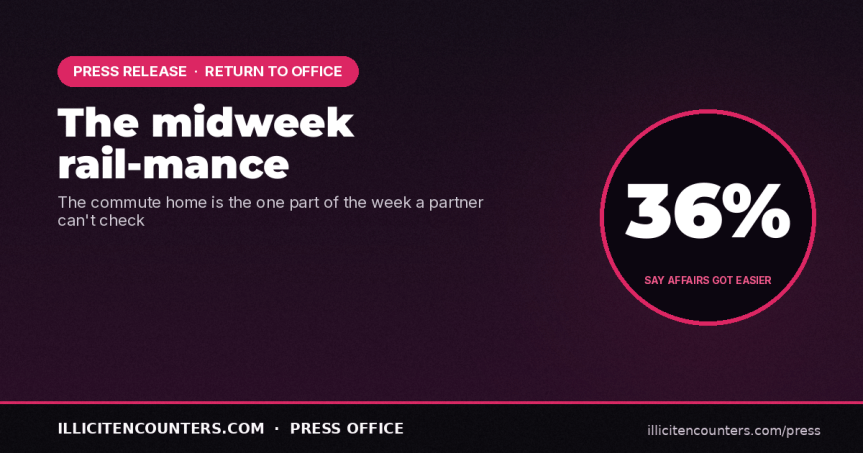
36% of cheats say going back to the office has made arranging an affair easier than working from home ever was — and it is the commute, not the office, where the midweek ‘rail-mance’ happens

Key findings

  • 36% of members say being back in the office has made arranging an affair easier than it was when they worked from home. Almost none of it happens at work.
  • 52% say the commute is the only part of the week a partner cannot account for.
  • Two thirds have used a drink near the station before the train home, and 55% have blamed a train that was late or never turned up.
  • Midweek sign-ups are up 32% on the same period last year, peaking on Tuesday and Wednesday between 5pm and 7pm. The site calls them rail-mances.
  • From a poll of 1,400 married members by IllicitEncounters.com, the UK’s leading extramarital dating site, and the site’s own registration data.

The train home is the one part of the week nobody checks. Not the office, where there are colleagues. Not the house, where there is a partner. Just the forty minutes in between, and the hour before it that nobody can account for.

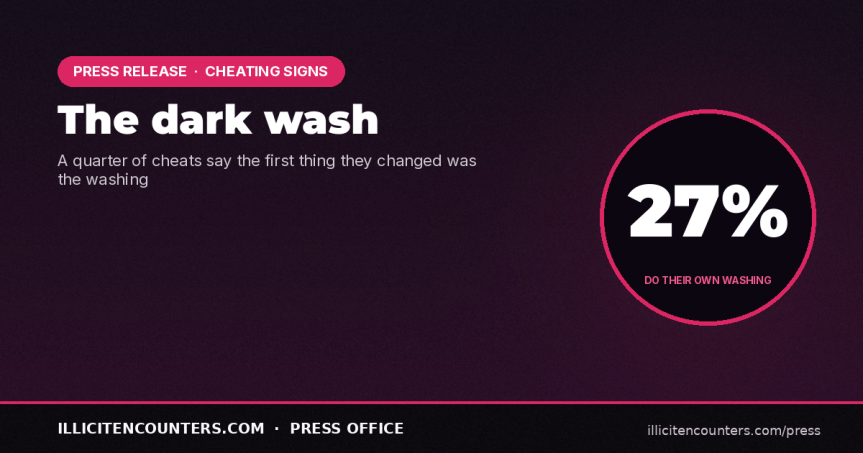
Bosses have spent years ordering people back to their desks, and office attendance is now at its highest in five years. Hardly anyone has gone back five days a week. What most people got instead is a fixed day or two in town, and IllicitEncounters.com, the UK’s leading extramarital dating site, asked 1,400 married members what that has done to their marriage. 36% said the office day has made arranging an affair easier than it ever was when they worked from home.

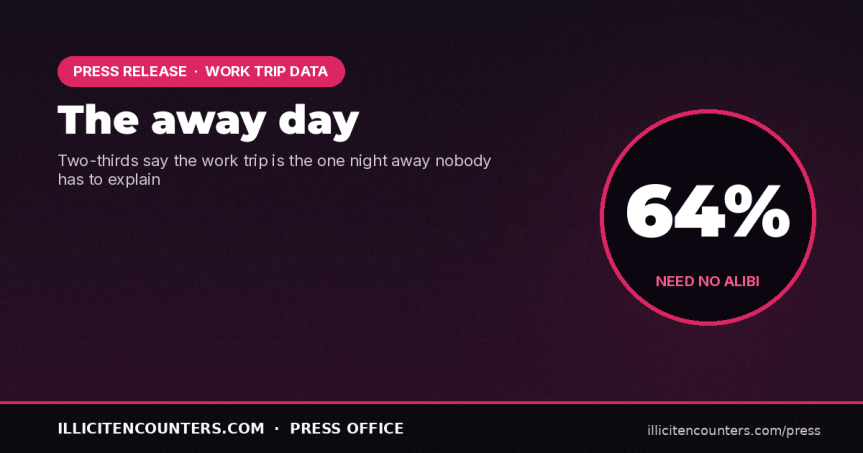
Almost none of it happens at work. The office day itself is a day at a desk — what changed is the hours bolted onto either end of it. 52% said the commute is the only part of the week a partner cannot account for, and asked what they actually do with it, two thirds named a drink near the station before the train home. 55% have blamed a train that was late or never turned up.

The site has started calling them rail-mances.

Chris*, 43, from Reading, is in the office on Tuesdays and Wednesdays. “That’s it, that’s the whole arrangement,” he says. “Nobody at home knows what time the 18:42 actually gets in, and nobody has ever checked. I’m not clever about it. I just get the later train.”

The site’s own figures say the same thing. Midweek sign-ups are running 32% above the same period last year, and they peak on Tuesday and Wednesday between five and seven — the two days the offices are fullest, and the two nights a partner is least likely to ask.

Hannah*, 39, from Leeds, goes in on a Tuesday. “My husband thinks Tuesday is my late one. It is a late one. It’s just not late because of work.”

Jessica Leoni, sex and relationships expert for IllicitEncounters.com, said: “We have started calling them rail-mances, because they nearly all start in the same place — a drink near the station and a later train home. A partner knows what the office looks like and they know what home looks like. They have no idea what the forty minutes in between looks like, and they have never once had a reason to ask.”

She added: “Working from home was terrible for affairs. There was no reason to be anywhere and no gap in the day that anybody could use. A mandated office day hands people back a reason, a postcode and a train time, and that is all anyone has ever needed. The bosses who called everybody back have done more for our business than any advert we have ever run.”

Results

What the office day is used for (of the 36% who say office days have made an affair easier; more than one answer allowed)

Use of the office day% who have used it
A drink near the station before the train home67%
“Working late” on an office day62%
Blaming a delayed or cancelled train55%
A hotel near the terminus40%
Meeting someone who uses the same line31%
Lunchtime, well away from the home postcode25%
Getting an earlier train in17%

*Names have been changed.

About Illicit Encounters

IllicitEncounters.com is the UK’s largest and longest-running extramarital dating site, established in 2004. The site has over one million UK members and publishes regular research on modern infidelity and relationships in Britain, with expert commentary from sex and relationships expert Jessica Leoni.

Press contact: [email protected]
‘We agreed we’d wait until she left’: a quarter of parents say their marriage ends the day their child moves out

Key Findings

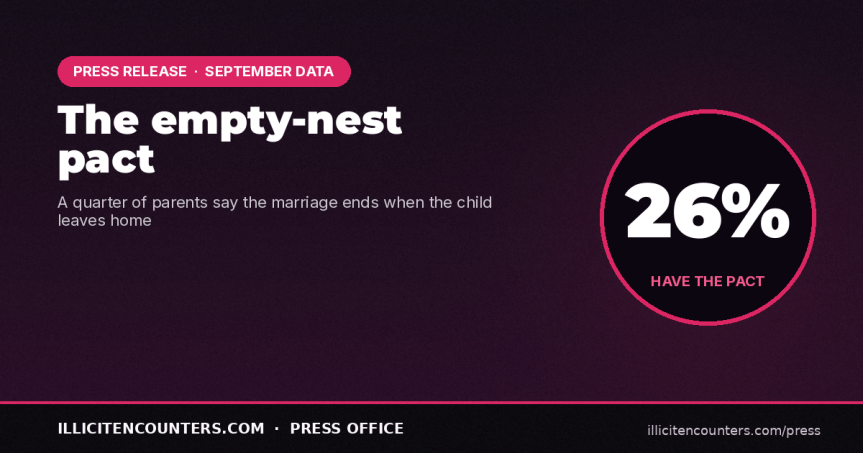
·       26% of members with a child leaving home this year say the marriage ends once they go, an arrangement the site has dubbed the ‘empty-nest pact’.

·       Of those, 58% say it was agreed more than five years ago, and 21% put it at more than a decade.

·       Sign-ups from members aged 45 to 54 are forecast to rise 39% across September, against the August average.

·       The results come from a poll of 1,600 members by IllicitEncounters.com, the UK’s leading extramarital dating site, and the site’s own registration forecasts.

The cars have been loading since the start of the month. By the beginning of October most of this year’s students will be living somewhere else, in a city their parents will from now on only visit. For a quarter of those parents, according to new research, that is also the week the marriage ends.

IllicitEncounters.com, the UK’s leading extramarital dating site, has started calling it the empty-nest pact: an agreement to stay together until the youngest has gone, sometimes said out loud and more often not.

The site polled 1,600 members who are parents. Of those with a child leaving home this year, 26% said the marriage would end once the child had gone.

Very few described it as a recent decision. Of the parents who reported such an arrangement, 58% said it had been agreed more than five years ago, and 21% put it at more than a decade. That is half the child’s life.

Asked what had kept them going in the meantime, 63% pointed to shared logistics rather than affection: the school run, the fixtures, the holidays that only really work with two adults in the house.

The finding lines up with separate research by Direct Line, which found that 22% of parents had stayed in a relationship longer than they wanted to for the sake of their children, and that those who did stayed an extra five and a half years on average. IE’s members date the pact at more than five years old.

Mothers were more likely than fathers to say it had been discussed out loud, at 34% against 19%. Fathers described something both of them understood and neither had said.

The site’s own figures point the same way. Sign-ups from members aged 45 to 54 are forecast to rise 39% across September, against the August average. The sharpest days are Sundays, once the parents have driven home.

Helen*, 49, from Sheffield, joined in the week after she drove her daughter to Leeds. “We’d said it out loud once, about eight years ago, and then we never mentioned it again,” she says. “It wasn’t a row. We both just knew. I’d driven back on my own, made a cup of tea, and that was that.”

Jessica Leoni, sex and relationships expert for IllicitEncounters.com, said: “We can almost set our watch by this one. It’s every September, without fail, and parents join to tell us they’ve been counting down since the child was in Year 9. There’s no crisis and no big row. They’ve just reached the end of an agreement they made a very long time ago.”

She added: “I’ve had this conversation with more parents than I could count, and what still surprises me is how calm they are about it. Nobody’s shouted. Nobody’s stormed out. They’ve packed the car, put the shelves up in halls, driven home and then sat down to work out who’s moving where. If you want to know how long a marriage has really been over, ask when the youngest started secondary school.”

Results

What has kept the marriage going until now (of those with an empty-nest pact; respondents could select more than one)

Reason given% of those with an empty-nest pact
Shared logistics: school run, fixtures, holidays63%
Not wanting to disrupt exams54%
The cost of running two households47%
Keeping the family home until they leave41%
What extended family would say28%
Still being friends24%
Hoping it would improve on its own19%

*Name has been changed.

About Illicit Encounters

IllicitEncounters.com is the UK’s largest and longest-running extramarital dating site, established in 2004. The site has over one million UK members and publishes regular research on modern infidelity and relationships in Britain, with expert commentary from sex and relationships expert Jessica Leoni.

Press contact: [email protected]
The anniversary reckoning: a third say their wedding anniversary was the moment they accepted the marriage was over

Key findings

  • 34% of members say a wedding anniversary was the point they accepted their marriage was over, a pattern the site has dubbed ‘the anniversary reckoning’.
  • Of those, 42% joined the site within six months of that anniversary.
  • Asked what happened on the night, 58% said they simply ran out of things to say to each other.
  • August is consistently one of the site’s busiest months for new sign-ups, and a poll of last August’s joiners found 68% had been married ten years or more.
  • The results come from a poll of 2,000 members by IllicitEncounters.com, the UK’s leading extramarital dating site, and the site’s own registration data.

Most British weddings happen in summer, which makes August the busiest month of the year for anniversaries – hundreds of thousands of couples marking another year over a booked table, a card bought on the way home and a conversation that runs out somewhere around the main course. Not all of it is celebration.

New research from IllicitEncounters.com, the UK’s leading extramarital dating site, suggests a good number are using the occasion for something else entirely. In a poll of 2,000 members, 34% said a wedding anniversary was the point at which they accepted their marriage was over – the site has started calling it the anniversary reckoning.

It describes the one evening a year when a couple are required to sit opposite each other, look at the photographs and account for the time.

The site’s own figures fit the same shape. August is consistently one of its strongest months for new registrations — the same pattern the site described in its recent research on the six-week itch — and a poll of 600 members who joined last August found that 68% had been married for ten years or more, the group most likely to be marking a milestone that month.

What they describe is the evening rather than the number. Asked what actually happened on the night, 58% said they ran out of things to say to each other, and 51% spent most of it talking about the children or the week ahead.

37% said one of them raised the state of the marriage and the other changed the subject – the point, several said, at which they stopped trying.

Almost none of it is sudden. 61% said they had felt it for more than a year beforehand, and of those who named an anniversary, 42% joined within six months of the date – very few in the weeks leading up to it.

Women were more likely than men to say the occasion crystallised something, at 39% against 28% – men more often described it as the excuse they had been waiting for, rather than anything that felt like a revelation at the time.

Rachel*, 44, from Derby, joined four months after her twentieth. “We did the restaurant and the photos on the wall and the card,” she says. “Somewhere around the dessert I realised I had nothing to ask him that I did not already know the answer to.”

Jessica Leoni, sex and relationships expert for IllicitEncounters.com, said: “We get a lot of emails in September that start with the words ‘we had our anniversary last month’. Not angry ones. Very ordinary, quite polite emails from people who booked a table, got through the evening and then sat in the car park afterwards not saying anything.”

She added: “I have been reading these emails since 2004 and I have never got used to how specific people are about the date. They remember the restaurant. They remember what they ordered. Somebody told me last year that she knew it was finished when her husband ordered for her and got it wrong, and she realised she had not corrected him in about a decade.”

Results

What happened on the anniversary evening (of those who named an anniversary as the moment; respondents could select more than one).

What happened on the night %
We ran out of things to say to each other 58%
We talked only about the children or the week ahead 51%
One of us was on our phone for most of it 44%
One raised the marriage, the other changed the subject 37%
We looked at the wedding photographs 29%
We went home earlier than booked 22%

*Name has been changed.

About Illicit Encounters

IllicitEncounters.com is the UK’s largest and longest-running extramarital dating site, established in 2004. The site has over one million UK members and publishes regular research on modern infidelity and relationships in Britain, with expert commentary from sex and relationships expert Jessica Leoni.

Press contact: [email protected]
‘We talked every day for a year and never met’: 38% of affairs now happen entirely through a screen, and members say they hurt more than a one-night stand

Key findings

  • 38% of members say they have had a relationship outside their marriage that never became physical, conducted entirely through messages, voice notes and calls. The site has dubbed it the ‘pod affair’.
  • They are not brief. Those relationships ran for an average of eleven months, and 29% lasted more than two years.
  • 44% of that group would call it cheating. 78% say their partner would. That gap is the argument most of them are dreading.
  • 61% say it did more damage than a one-night stand would have, because there was more of it and it was harder to explain away.
  • The results come from a poll of 2,000 members by IllicitEncounters.com, the UK’s leading extramarital dating site.

Love Is Blind UK returns to Netflix on Wednesday, and the premise is the same as it has always been. Strangers talk to each other through a wall for days on end, with no face, no photograph and no touching, and some of them come out the other side saying they are in love. It is presented as a stunt. New research suggests a version of it is going on in a very large number of British marriages already.

IllicitEncounters.com, the UK’s leading extramarital dating site, polled 2,000 of its members. 38% said they had been in a relationship outside their marriage that never once became physical. No meeting, no hotel, nothing that would show up on a bank statement. The site has started calling it the pod affair.

They tend to run for a long time. The average was eleven months, and 29% went on for more than two years. Most were conducted in writing, with 71% saying the bulk of it happened in messages and voice notes rather than on the phone or on video.

The most striking finding is the disagreement about what it even is. 44% of the members who had one would describe it as cheating. Asked what their partner would say, 78% thought their partner would call it cheating. Almost twice as many people expect to be judged for it as judge themselves.

And they do not think it was the softer option. 61% said it had done more damage than a one-night stand would have done, on the grounds that there was simply more of it, it went on for longer, and there was no version of events in which it could be written off as a mistake on one particular night.

Nadia*, 41, from Bristol, messaged the same man every day for over a year and never met him. “It started because we were both awake at half six and neither of us wanted to be,” she says. “It was nothing, really. What we’d watched, his mother, my knee. Then one morning I told him my scan results before I told my husband, and I sat there looking at the message thinking, that is not a friend. I have never once been in a room with him. I would still know his voice anywhere.”

Jessica Leoni, sex and relationships expert for IllicitEncounters.com, said: “Everybody is about to watch a programme where people fall in love through a wall, and half the country will talk about it like it is a gimmick. It is not. We have members who have carried on for a year with somebody they have never once been in a room with. No hotel, no meeting, nothing you could photograph.”

She added: “Twenty-two years I have been doing this, and the ones who get caught this way take it hardest. There is nothing to point at. No receipt, no hotel bill, no lipstick on anything. Just eleven months of voice notes and the fact that he told her things first. Try explaining to a wife that nothing happened. She has read it. She knows exactly what happened.”

Results

What made it stop feeling like a friendship (of the 38% who had a screen-only relationship; respondents could select more than one).

What crossed the line %
Telling them something before telling my partner 74%
Messaging first thing in the morning and last thing at night 66%
Deleting the conversation 57%
Talking about my marriage to them 49%
Saving them under a different name 35%
Making plans we both knew would not happen 23%

*Name has been changed.

About Illicit Encounters

IllicitEncounters.com is the UK’s largest and longest-running extramarital dating site, established in 2004. The site has over one million UK members and publishes regular research on modern infidelity and relationships in Britain, with expert commentary from sex and relationships expert Jessica Leoni.

Press contact: [email protected]

Two weeks down, four to go: the ‘six-week itch’ sees affair site sign-ups jump 34% as parents hit the school-holiday wall

Key findings

  • Sign-ups to IllicitEncounters.com are already running 34% above the school-term average, just two weeks into the six-week summer holiday.
  • Women account for 58% of new members so far this holiday, and 46% of those are aged 35 to 44.
  • The busiest hour for joining is 9pm to 10pm, once the children are in bed, accounting for 22% of daily sign-ups.
  • Asked what tipped them over the edge, 61% said having no time alone as a couple, ahead of constant childcare rows (48%).
  • The results come from registration data and a poll of 2,000 members by IllicitEncounters.com, the UK’s leading extramarital dating site.

Britain’s schools broke up a fortnight ago and there are still four weeks of it to go – which, according to new research, is about a fortnight longer than a good many parents can comfortably stand. The novelty, it seems, has a short shelf life.

IllicitEncounters.com, the UK’s leading extramarital dating site, has recorded sign-ups running 34% above its school-term average since the schools shut – a figure it expects to pass 45% in the final fortnight of August. It has a name for the pattern: the six-week itch.

The site also polled 2,000 members who have joined or become active since the start of the holidays. Asked what pushed them to join, 61% pointed to having no time alone as a couple, followed by constant childcare rows (48%), a partner who had checked out on the sofa (44%) and a sex life shelved until September (39%). Respondents could pick more than one.

The summer intake also looks rather different from the rest of the year. Women make up 58% of new members so far this holiday, against 51% in term time – and of those women, 46% are aged between 35 and 44, the bracket most likely to have primary-school-age children at home.

The registration data also shows when the itch tends to bite. Sign-ups have climbed every week since the schools shut, and the average member who joined this holiday did so 11 days in.

And there is a clear hour for it – 22% of daily sign-ups now land between 9pm and 10pm, once the children are down and the house has finally gone quiet.

The pattern fits what the site records later in the year, when registrations climb again in the first week of September, once parents have the house back and the school day to themselves. The summer sign-up tends to come first; the chance to act on it arrives a few weeks later. It is the same August spike behind the site’s recent research on the anniversary reckoning, when a wedding anniversary falling in the school holidays can be the moment a marriage tips.

Claire*, 38, from Warrington, joined in the last week of July. “I love them to bits, but I don’t think I’ve had a conversation that wasn’t about snacks or screen time since they broke up,” she says. “Me and my husband just tag in and tag out. He does the morning, I do the afternoon. By nine o’clock he’s on his phone and I’m on mine, and that’s it, that’s the evening. I signed up on one of those nights. I wasn’t even really looking for anything. I just wanted somebody to find me interesting for ten minutes.”

Jessica Leoni, sex and relationships expert for IllicitEncounters.com, said: “We are two weeks in and it has already started, which tells you something. Most parents can get through a fortnight of packed lunches and soft play – it’s weeks three, four and five that do the damage, when the money has gone and September still feels a very long way off.”

She added: “I have been doing this for over 20 years and August is always our busiest month for parents. The holidays don’t break a marriage. They take away the distractions that were holding it together, and people notice what has been missing. Nobody signing up this week is running away from their children. They are looking for one hour where somebody talks to them like an adult.”

Results

What tipped parents into joining in the first fortnight of the school holidays (respondents could select more than one).

Trigger % of those polled
No time alone as a couple 61%
Constant childcare rows 48%
Partner checked out on the sofa 44%
Sex life shelved until September 39%
No conversation beyond logistics 33%
Money stress over the holidays 27%
Feeling invisible to a partner 24%

*Name has been changed.

About Illicit Encounters

IllicitEncounters.com is the UK’s largest and longest-running extramarital dating site, established in 2004. The site has over one million UK members and publishes regular research on modern infidelity and relationships in Britain, with expert commentary from sex and relationships expert Jessica Leoni.

Press contact: [email protected]

Forget the villa: a third of Brits admit to a real-life ‘Casa Amor’ — straying, or coming close, the moment their partner’s back is turned

Key findings

  • 34% of coupled-up Brits admit they’ve strayed, or come close, while their partner was away – their own real-life ‘Casa Amor’. For 16% of all those polled, it went all the way.
  • Work trips are the biggest danger zone (39%), ahead of girls’ and lads’ holidays (31%) and stag and hen weekends (22%).
  • As Love Island crowned Lorenzo and Julia on Monday night, 68% of Brits are betting the couple won’t last the year.
  • 41% say watching the show has started a row at home about loyalty, jealousy or an ex.
  • The results come from a poll of 2,000 members by IllicitEncounters.com, the UK’s leading extramarital dating site.

Britain spent last night glued to the Love Island final, watching Maya Jama crown Lorenzo Alessi and Julia Majchrzak as the couple who survived every bombshell and Casa Amor twist the villa could throw at them. Turns out plenty of us have taken that same test ourselves, off camera. And failed it.

IllicitEncounters.com, the UK’s leading extramarital dating site, put the question to 2,000 of its members, and 34% owned up to a Casa Amor moment of their own: a spell when their partner was away and they either strayed or came very close to it. Most stopped at the brink. But for 16% of everyone polled – roughly one in six – it went all the way.

The danger zones will surprise nobody who watches the show. Work trips came out top, with 39% pointing to a night away for the job as the moment temptation crept in, followed by the girls’ or lads’ holiday (31%) and the stag or hen do (22%). Men were quicker to act on it: 21% went through with it, against 12% of women, who were more likely to wobble and pull back at the last minute.

The show causes its share of trouble at home too. 41% of members said watching Love Island had started a row with their partner about loyalty or jealousy, usually during Casa Amor week, or when somebody got a bit too defensive about a contestant whose head had been turned.

The site’s own traffic tells the same story. Visits to IllicitEncounters.com climbed 24% during Casa Amor week, its busiest stretch of the whole summer, and it was women doing most of the messaging. The pattern echoes the site’s recent research on holiday flings, which found a third of Brits say a fling on holiday doesn’t really count.

As for Lorenzo and Julia, don’t expect the members to send a card. 68% reckon the couple won’t make it to next summer. Some of that is Love Island’s track record talking. But plenty of IE’s members were once the couple everyone else envied.

Chloe*, 34, from Nottingham, had her own Casa Amor moment on a hen weekend. “I honestly wasn’t looking for anything,” she says. “But the minute I was away from home it was like the normal rules didn’t count. That’s the bit people don’t admit about the villa – you tell yourself it doesn’t matter because you’re somewhere else, with different people around you.”

Jessica Leoni, sex and relationships expert for IllicitEncounters.com, said: “Everyone’s very quick to shout at the telly when somebody’s head gets turned in Casa Amor. But be honest – how many of us would actually pass that test? Take someone out of their routine, put them somewhere new where nobody knows them, and you find out very quickly how solid things really are back home.”

She added: “I’ve been doing this for over 20 years and I’ve never once seen a work trip make somebody cheat. What the time away does is remove whatever was stopping them. If things are good at home, a few nights in a Travelodge is just a few nights in a Travelodge. If they’re not, it starts to feel like your own private Casa Amor – and hand on heart, that feeling was there long before the show came back on.”

Results

When Brits are most likely to have a real-life ‘Casa Amor’ moment (respondents could select more than one).

When a ‘Casa Amor’ moment is most likely (partner away) % who’ve been tempted
On a work trip or conference away from home 39%
On a ‘girls’ / lads’ holiday 31%
On a stag or hen weekend 22%
When a partner visits family without them 17%
When a partner is away with the kids 11%
On a night out when a partner has gone home early 9%

*Name has been changed.

About Illicit Encounters

IllicitEncounters.com is the UK’s largest and longest-running extramarital dating site, established in 2004. The site has over one million UK members and publishes regular research on modern infidelity and relationships in Britain, with expert commentary from sex and relationships expert Jessica Leoni.

Press contact: [email protected]

It doesn’t count if it’s abroad: 1 in 3 Brits say a holiday fling isn’t really cheating

Key findings

  • 34% of Brits say being unfaithful with someone else while on holiday “doesn’t count” as infidelity.
  • 41% believe a holiday fling is fundamentally different from an affair at home – citing distance, anonymity and the “holiday version of themselves” as reasons.
  • 27% say what happens abroad should stay abroad – and their partner would agree.
  • 19% admit they’ve acted on that belief; of those, 74% say they have no regrets.
  • Study conducted by IllicitEncounters.com, the UK’s largest extramarital dating site.

It’s one of Britain’s most quietly held beliefs – and according to new data, a surprisingly large number of people genuinely stand by it: if it happens abroad, it doesn’t really count.

A poll of 2,000 adults conducted by IllicitEncounters.com, the UK’s largest extramarital dating site, has found that 1 in 3 Brits (34%) do not consider a sexual encounter with someone else while on holiday to constitute cheating – at least not in the traditional sense. And with the peak summer holiday season now under way, the timing could not be more relevant.

The reasoning, it turns out, is remarkably consistent. 41% say a holiday fling feels fundamentally different from an affair at home – citing the distance from normal life, the anonymity of being somewhere nobody knows you, and what several respondents described as becoming a “different version of themselves” the moment they land. The rules of home, they argue, simply don’t follow you through the departure gate.

27% go further still, saying not only do they believe what happens abroad stays abroad – but that their partner, on some level, would quietly agree. A kind of unspoken holiday amnesty, observed but never discussed.

19% admit they have acted on that belief at some point in their relationship – and never mentioned it to their partner. Of those, 74% say they have no regrets, and 61% say it had no negative impact on their relationship whatsoever.

The holiday locations most associated with the “it doesn’t count” mentality are, perhaps unsurprisingly, the sun-and-sangria circuit. Spain topped the list, cited by 37% of respondents, followed by Greece (30%), Ibiza specifically (28%), Dubai (22%) and Italy (19%).

The pattern shows up again in a separate strand of the site’s summer research on real-life Casa Amor, which found a third of Brits admit to straying, or coming close, the moment their partner’s back is turned – with the girls’ or lads’ holiday abroad one of the most likely settings.

“Mark*”, 43, from Leeds, is unrepentant. “I’ve been with my wife for fifteen years and I love her completely. But I’ve had two holiday flings in that time – once in Barcelona, once in Dubai – and I genuinely don’t think of either as cheating. You’re in a different country, you’re a different person, and it goes no further. It stays there. That’s just how I see it.”

Jessica Leoni, spokesperson for IllicitEncounters.com, said: “The ‘it doesn’t count abroad’ rule is one of the great unspoken agreements in British relationship culture – and our data suggests it’s far more widespread than most people would admit at a dinner party. What’s interesting is that it isn’t just men saying this. Women are almost equally likely to hold this view, which tells you something about how the idea of a ‘holiday self’ has become genuinely embedded in the way Brits think about fidelity.”

She added: “Whether it counts or not is, of course, entirely a matter of what you and your partner have agreed – explicitly or otherwise. But the fact that nearly 1 in 5 people have acted on this belief and never told their partner suggests that for a significant chunk of the population, the holiday fling occupies its own moral category entirely. Not quite an affair. Not quite nothing. Just something that happened in the sun, and stayed there.”

Results

Top destinations where Brits have had holiday affairs.

Destination %
Spain 37%
Greece 30%
Ibiza 28%
Dubai 22%
Italy 19%
Tenerife 18%
Turkey 15%
Portugal 10%
Mexico 6%
Thailand 5%

*Name has been changed to protect identity.

About Illicit Encounters

IllicitEncounters.com is the UK’s largest and longest-running extramarital dating site, established in 2004. The site has over one million UK members and publishes regular research on modern infidelity and relationships in Britain, with expert commentary from sex and relationships expert Jessica Leoni.

Press contact: [email protected]

Kim Kardashian & Lewis Hamilton go Instagram-official – and relationship experts say the “new rush” may not last

The key findings

* Kim Kardashian and Lewis Hamilton finally confirm their relationship with an Instagram reveal.

* The pairing follows a familiar pattern among high‑profile, high‑achieving individuals whose past relationships struggled under pressure.

* Relationship expert at IllicitEncounters.com, Jessica Leoni explains why the “new rush” of a power‑couple romance is so intoxicating – and why it often doesn’t last.

Kim Kardashian and Lewis Hamilton have finally gone Instagram‑official, after months of speculation linking the reality star and the Formula One champion.

Hamilton posted a video on Instagram featuring Kim in the passenger seat – the first time either has publicly acknowledged the relationship. The pair first fuelled rumours at Super Bowl LX in February, were spotted hand‑in‑hand in Tokyo in March, and sources close to the couple now claim they’re “in love.”

Expert comment from Jessica Leoni

But according to Jessica Leoni, sex and relationships expert at IllicitEncounters.com, the pairing follows a familiar pattern among high‑achieving, high‑profile individuals whose past relationships have struggled under the weight of ambition, fame and relentless schedules.

Commenting on the now Instagram-official couple, she said, “Kim and Lewis are both used to being the most powerful person in the room – and that’s exactly what makes the early rush of a relationship like this so intoxicating. The thrill of the new is unbelievably addictive, especially for people whose lives are built around pressure, performance and public scrutiny.

But that same intensity is often what causes these relationships to crack. When both partners lead, neither is wired to compromise. And that’s when people start seeking emotional intimacy somewhere the power dynamic feels different.

For now, they’re in the sweet spot – the high, the excitement, the escape. But the real story will be what happens when the rush settles and real life returns. That’s where the people left behind often feel the impact most.”

Further Reading

For more on this topic, explore affair dating on Illicit Encounters.

Brainy Brits are the most likely to have an affair – but which degree comes out on top?

The key findings

* 81% of people who cheat have a university degree
* Law graduates top the list of degree holders most likely to stray
* Psychology, Business and Computer Science graduates also feature heavily
* Study conducted by IllicitEncounters.com, the UK’s largest extramarital dating site

Britain’s most educated are also among the most unfaithful, with new research revealing that university graduates are significantly more likely to stray – and those with law degrees are leading the pack.

A new study by IllicitEncounters.com, the UK’s leading married dating site, involving 3,500 members has found that a striking 81% of people who cheat hold a university degree.

When asked what subject they studied, law graduates emerged as the most likely to have an affair, accounting for 19% of degree-holding cheats – putting their finely honed skills of persuasion and loophole-finding to rather creative use outside the courtroom. Business graduates follow at 17%, with Psychology graduates in third at 15%.

Computer Science graduates account for 13%, no doubt relying on their tech savvy to ensure there’s no digital evidence left behind, while Marketing and Media Studies alumni clock in at 11%.

One member of the married dating site, a solicitor from Birmingham in her late thirties, says the findings don’t surprise her at all. “Lawyers are trained to compartmentalise,” she says. “You learn very early on to keep different parts of your life completely separate. It’s practically a professional requirement – it just turns out it’s quite a useful skill in your personal life too.”

Expert comment from Jessica Leoni

Jessica Leoni, sex and relationships expert at IllicitEncounters.com, says the pattern reflects the pressures that often accompany high-achieving careers. “Graduates tend to be ambitious, driven and intellectually restless – and those same qualities that make them successful professionally can make it very difficult to switch off that hunger at home. They want stimulation in every area of their lives, and if they’re not getting it in their marriage, they’ll find it elsewhere.”

She adds: “The law graduate finding is particularly fitting. If anyone knows how to build a watertight case – and cover their tracks – it’s a barrister.”

Results

Law – 19%
Business – 17%
Psychology – 15%
Computer Science – 13%
Marketing / Media Studies – 11%
Management Studies – 8%
Engineering – 6%
Economics – 5%
English Literature – 4%
Languages – 3%
Fine Art – 2%

Further Reading

For more on this topic, explore married dating on Illicit Encounters.

Brits admit secretly checking their partner’s phone at least once a week – and many don’t think it’s wrong

The key findings

* More than half of Brits admit snooping on their partner’s phone without permission
* Over a quarter say they check their partner’s device at least once a week
* Women are significantly more likely to snoop than men
* Study conducted by IllicitEncounters.com, the UK’s largest extramarital dating site

Smartphones may hold the secrets of our daily lives – but for many couples, they’ve also become a source of temptation.

A new poll of 2,500 people conducted by IllicitEncounters.com, the UK’s largest extramarital dating site, has revealed that 52% of Brits admit they have secretly checked their partner’s phone without permission.

And for many, it’s not just a one-off act of curiosity. Among those who confessed to snooping, 27% admitted they check their partner’s phone at least once a week, suggesting that secret surveillance has become a regular habit in some relationships.

When asked how often they had secretly checked their partner’s phone, 12% admitted doing so every day, while 27% said they snoop at least once a week. A further 19% said they check around once a month, while 42% insisted they had only done it once or twice out of curiosity.

Despite the obvious privacy implications, many respondents didn’t feel particularly guilty about their behaviour. In fact, 34% of those who admitted snooping said they didn’t consider secretly checking their partner’s phone to be “that bad.”

For some, however, the habit has led to uncomfortable discoveries. 27% of those who checked their partner’s device said they found something upsetting, whether that was suspicious messages, conversations they felt crossed a line, or evidence of behaviour their partner had previously denied.

The research also revealed a clear gender divide when it comes to phone snooping. Women were more likely to admit checking their partner’s phone, with 58% confessing to doing so compared to 46% of men.

One woman who took part in the survey, a 35-year-old sales manager from Manchester who asked to remain anonymous, said curiosity initially drove her to look through her partner’s phone.

“It started as a gut feeling more than anything,” she says. “He’d started turning his phone face down on the table and taking it with him everywhere, even just to make a cup of tea. I told myself I was being paranoid, but the thought wouldn’t leave my head.”

Eventually, she decided to take a look while he was asleep. “I hated the idea of snooping, but at the same time I felt like I needed reassurance,” she says. “Once you’ve had that suspicion planted in your mind, it’s really hard to ignore it.”

What she found wasn’t outright evidence of cheating, but it was enough to shake her trust. “There were messages with another woman that felt a bit too friendly for my liking,” she says. “Nothing explicit, but lots of late-night chats and inside jokes. It made me feel like there was something emotional going on that I didn’t know about.”

Expert comment from Jessica Leoni

Jessica Leoni, sex and relationships expert at IllicitEncounters.com, says the findings highlight how smartphones have become a major issue for modern relationships. “Phones contain so much of our personal lives now – messages, social media conversations, photos and browsing history,” she explains. “For someone who already feels insecure in their relationship, the temptation to look can be overwhelming.”

However, she warns that snooping can often create more problems than it solves. “Checking a partner’s phone might provide temporary reassurance, but it can also damage trust if the behaviour becomes habitual,” she says. “In many cases, it reflects deeper issues in the relationship, such as insecurity, poor communication or a lack of transparency.”

Leoni adds that once someone begins regularly checking their partner’s phone, it can quickly become a cycle that’s difficult to break. “Suspicion often feeds itself,” she says. “The more someone looks for evidence of wrongdoing, the more likely they are to interpret normal behaviour as something suspicious. Healthy relationships depend on trust – and that’s very difficult to maintain if one partner feels constantly monitored.”

Results

Have you ever secretly checked your partner’s phone without their permission?
Yes – 52% (58% women, 46% men)
No – 48% (42% women, 54% men)

How often do you check your partner’s phone? (Of those who admitted to checking without permission)
Every day – 12%
At least once a week – 27%
At least once a month – 19%
At least once a year – 42%

Further Reading

For more on this topic, explore discreet dating on Illicit Encounters.