
Brits split over what REALLY counts as cheating – and there’s no going back if you do this one thing

* New research reveals Brits are far more forgiving of digital slip‑ups than physical or emotional betrayals.

* Liking photos and harmless crushes top the list, while emotional affairs rank as the hardest to excuse.

* Experts say the findings show how modern couples draw very different lines between impulsive mistakes and deeper breaches of trust.

* Study conducted by IllicitEncounters.com, the UK’s largest extramarital dating site

New research has revealed the nation’s surprisingly forgiving hierarchy when it comes to infidelity – and it turns out not all cheating is created equal.

The poll of 2,000 Brits conducted by IllicitEncounters.com, the UK’s largest extramarital dating site, asked respondents to choose the single most forgivable form of cheating from a list of seven common betrayals. 

At the softer end of the scale, liking photos on social media emerged as the most forgivable behaviour, with 29% of people saying they could let it slide. 

18% said they could forgive their partner for having a crush on a work colleague, suggesting that fleeting feelings are seen as human – as long as they don’t turn into action.

Things became murkier when digital behaviour turned more intimate. Flirty texting with an ex was considered forgivable by 15%, while having a dating app profile – even without meeting anyone – was acceptable to 14% of respondents. 

Physical cheating proved harder to excuse. Kissing someone else was seen as forgivable by 11%, but only 9% said they could move past a one‑night stand or sex with someone else. 

The least forgivable act of all was an emotional affair, with only 4% saying they’d be able to look past it.

Sex and relationship expert at IllicitEncounters.com, Jessica Leoni, believes the findings highlight how differently people define betrayal. “Cheating isn’t a one-size-fits-all concept anymore,” she said. “For some couples, liking a photo is meaningless. For others, it’s the start of a slippery slope. What this research shows is that people draw their red lines in very different places.”

She added that emotional infidelity can sometimes cut deeper than physical acts.“Many people see sex as a moment of weakness, particularly if alcohol or circumstance is involved,” Jessica explained. “But emotional affairs require time, secrecy and sustained investment. That’s often why they feel more threatening – they suggest a partner’s attention and affection are being redirected.”

One 34-year-old woman from Manchester, who asked not to be named, said she chose to forgive her husband after he admitted to a drunken one-night stand.

“It was devastating at first,” she said. “But when we talked it through, I realised it hadn’t been about feelings – it was a stupid decision in a single moment. What would have hurt more is if he’d been confiding in someone else for months behind my back.”

Leoni added that forgiveness often depends on context. “People are more likely to forgive something they can rationalise,” she said. “If it feels impulsive, they may see it as salvageable. But if it feels calculated or emotionally invested, it can be harder to come back from.”

Results

Which of these do you consider the most forgivable?

  • Liking photos on social media 29%
  • Having a crush on a work colleague 18%
  • Flirty texting with an ex 15%
  • Having a dating app profile 14%
  • Kissing someone else 11%
  • Sex with someone else 9%
  • An emotional affair 4%

Red Tuesday: Why tomorrow is the most popular day of the year to get dumped

* Nearly half of Valentine’s break-ups happen on ‘Red Tuesday’, with 49% choosing the day to end things before romance (and spending) kicks in.

* Money, guilt and emotional burnout are driving the split, as 41% dump partners to avoid Valentine’s costs and 38% admit they’re tired of faking affection.

* Most break-ups aren’t impulsive – over 80% had been planning it for days or longer, with after-work dumps the most common timing.

* Study conducted by IllicitEncounters.com, the UK’s largest extramarital dating site

Tomorrow marks Red Tuesday – the day Brits are statistically most likely to call time on their relationship as Valentine’s Day looms.

New research from IllicitEncounters.com, the UK’s largest extramarital dating site, reveals that the Tuesday before Valentine’s Day (10th February) is the single most popular day of the year to get dumped, as thousands of Brits perform a last-minute romantic U-turn to avoid the most amorous day of the year.

A poll of 1,500 members found that more than a third (34%) admit they have ended a relationship in the run-up to Valentine’s Day. Of those, almost half (49%) said they deliberately chose Red Tuesday to do it, making it the single most popular dumping day of the year.

So why are so many couples calling it quits just days before the most romantic date on the calendar?

Money plays a major role. Over two-fifths (41%) said they broke up to avoid the expense of Valentine’s Day altogether, admitting they didn’t want to splash out on gifts, meals or experiences for a relationship they knew wasn’t going anywhere.

Emotional honesty also came into play. 38% said they were tired of pretending everything was fine, while 29% admitted they no longer wanted to fake affection for the sake of one more “romantic” day.

Others saw Valentine’s Day as a line in the sand. Nearly a quarter (24%) said they wanted a clean slate before spring, while 19% confessed that guilt over seeing someone else pushed them to finally end things.

Timing, it seems, is everything – even when it comes to breakups. The poll found that most Red Tuesday splits happen at the end of the working day, with 37% ending things after work. Mornings accounted for 26% of breakups, while 21% happened at lunchtime. Just 16% waited until late at night, suggesting fewer people want to lie awake stewing after delivering bad news.

For many, deciding to call it quits wasn’t exactly spontaneous. Only 18% said they made the decision to end their relationship on that very day. A third (34%) had been planning it for a few days, 27% had sat on the decision for a week, and 21% admitted they’d been thinking about breaking up for much longer.

One member, Sarah*, 35, from Manchester, says Red Tuesday gave her the push she needed. “I knew by January that the relationship was over, but Valentine’s Day hanging over us made it feel urgent,” she says. “I didn’t want to sit through a forced dinner pretending we were happy. Ending it before felt brutal, but also like a relief.”

Jessica Leoni, sex and relationships expert at IllicitEncounters.com, says Red Tuesday is all about timing and avoidance. “Valentine’s Day puts a spotlight on relationships, and not everyone likes what it shows,” she explains. “For many people, it forces a moment of honesty they’ve been avoiding.”

She adds: “There’s also a very practical side to it. People don’t want to spend money, make grand gestures or post loved-up photos when they know their heart isn’t in it. Red Tuesday becomes the moment they rip the plaster off and move on – even if it’s uncomfortable.”

Leoni says the surge in breakups shouldn’t come as a surprise. “Valentine’s Day is about commitment and affection. If a relationship is already on shaky ground, that pressure can be the final straw.”

* Name has been changed

Results
Reasons for breaking up before Valentine’s Day:
To avoid the expense of Valentine’s Day – 41%
No longer wanting to fake affection – 38%
Wanting to start fresh before spring – 24%
Feeling guilty about seeing someone else – 19%

What time of day did you end the relationship?
Morning – 26%
Lunchtime – 21%
After work – 37%
Late at night – 16%

How long had you been planning the breakup?
Same day – 18%
A few days – 34%
A week – 27%
Longer – 21%

Today is the day that people are more likely to start having an affair than any other time of the year

* Dubbed ‘Blue Monday for relationships’, the 5th January marks the day most people turn to infidelity after festive tensions expose cracks in their relationships.
* New registrations on IllicitEncounters.com are forecast to rise by 38% by the end of this week, prompting the site to bring in additional staff for the second consecutive year to cope with demand.
* 71% say ending an unhappy relationship is a top priority this year, while 56% admit having more sex is high on their 2026 to-do list.

As the decorations come down and reality bites, today is the day more Brits will choose to pursue an affair than any other day of the year, according to relationship experts – and it’s all driven by post-holiday blues and a desire for a fresh start.

The 5th January has been dubbed ‘Blue Monday for relationships’ – sharing the spotlight with Divorce Day, as both land on the first working Monday of the year.  

According to new data from IllicitEncounters.com, registrations are forecast to be 38% higher by the end of this week, making this one of the site’s busiest starts to a year on record. The surge has been so significant that additional customer support staff have been drafted in for the second consecutive year to manage the influx of new members seeking an affair..

The site also surveyed 1,000 members who joined during the first few days of January, revealing the emotional drivers behind the spike. A striking 64% said the festive period made them realise how unhappy they were in their relationship, while 49% admitted that spending extended time with their partner over Christmas confirmed feelings they had been trying to ignore.

When asked about their priorities for the year ahead, 71% said leaving an unhappy relationship or starting divorce proceedings was at the top of their list, followed closely by having more sex (56%), feeling desired again (51%), and putting their own happiness first (47%).

One woman who joined the site this week, Sarah*, 39, from Leeds, says Christmas was the final straw. “On paper, we had a perfect Christmas – family visits, big dinners, presents – but I felt completely invisible the entire time,” she says. “We barely spoke unless it was about logistics. When January arrived, I realised I couldn’t go into another year feeling this lonely. Signing up felt like taking control again.”

Jessica Leoni, sex and relationships expert for IllicitEncounters.com, says the timing is no coincidence. “The festive chaos is over, routines return, and people suddenly have space to act. That combination of clarity, dissatisfaction and opportunity makes early January the most dangerous period of the year for struggling relationships.

The post-Christmas surge in activity on IllicitEncounters has become so consistent that, for the second consecutive year, we’ve needed additional staff to manage the influx of new members. It underlines just how significant early January has become in the relationship calendar.”

“Christmas has a way of magnifying everything that isn’t working in a relationship,” she explains. “There’s pressure to be happy, affectionate and grateful — and when the reality doesn’t match the picture, it can be deeply confronting. By early January, people are emotionally exhausted and far more honest with themselves about what they’re missing.”

She adds: “January represents a psychological reset. For some, that means diets or gym memberships — but for others, it’s about reclaiming intimacy, excitement and feeling wanted again.”

*Name has been changed.

“I can’t afford to leave my partner – so I found freedom in an affair”

* A heartbreaking new poll reveals that 58% of people are trapped in unhappy marriages because they simply cannot afford to leave their partner.
* Of those financially constrained people, a massive 84% admit they would leave their husband tomorrow if they weren’t fearful of the financial impact of divorce.
* Susan* and Anthony* are just two examples of how worries of financial ruin through divorce can be a catalyst for infidelity.
* Study conducted by IllicitEncounters.com, the UK’s largest extramarital dating site.

For many people, divorce isn’t always a choice. Some stay in unhappy marriages not because of love, but because they simply can’t afford to leave – and for a growing number, that financial trap is pushing them towards affairs instead.

A new survey of 2,000 members (split evenly between men and women) on IllicitEncounters.com, the UK’s largest extramarital dating site, reveals that 58% of people admit they stay in their marriage for financial reasons – and of those, a staggering 84% say they’d leave tomorrow if they weren’t fearful of the financial impact of divorce.

For Susan, 50, from Dorset, that statistic hits painfully close to home. She’s been married for 15 years, but the love faded long ago. “ I stay because I can’t afford not to – there’s no affection, no sex, nothing romantic left. We even sleep in separate rooms.” she says.

Susan’s husband had an affair 14 years ago, when she was pregnant with their child. Though they stayed together, she says she “never truly forgave him” but feels she cannot leave because of the costs that would come with divorce. 

But it’s not just women who are feeling trapped because of the potential financial impact of divorce. Anthony*, a 53-year-old business consultant, says, “I have a great salary, and that’s exactly the problem. The thought of a divorce is terrifying – my wife would take half of everything I’ve spent my life building. She knows that, and I think on some level, she uses it to her advantage. We haven’t been intimate for years, but I stay because the alternative could destroy me financially.”

He says joining IllicitEncounters.com gave him “an escape” without the life-ruining cost of divorce. “It’s not about being a player or chasing excitement – it’s about feeling appreciated again, without losing everything I’ve built.”

Relationship expert Jessica Leoni, from IllicitEncounters.com, says these stories are increasingly common. “Financial entrapment is one of the hidden drivers of modern infidelity,” she explains. “Many people feel they have no real option to leave – the cost of housing, childcare, and living expenses means they’re effectively locked into their marriages. For some, an affair becomes a way to reclaim a piece of themselves without tearing their whole life apart.”

Sometimes it’s the only form of therapy and self-discovery that fits within their economic reality. They aren’t looking to blow up their family’s home; they’re looking for a way to survive living in it.”

*Name has been changed

“I’ve met 176 men on an affairs site – I refuse to be tied down again after my 19-year marriage ended”

* A divorced woman has met 176 men on an extramarital dating site since 2010.
* Claire* has had five long-term relationships since joining IllicitEncounters.com, the longest lasting six years.
* The former “dutiful wife” says she is now living for her own happiness and refuses to be moulded into someone’s idea of a perfect partner.

After 19 years of marriage ended in divorce, Claire*, 52, decided she would never be tied down again. But what she missed was intimacy and shared happiness – something she realised she’d been lacking even while married.

So, in 2010, she joined IllicitEncounters.com. Fifteen years later, she has met 176 men, received messages from “several thousand,” and has had five meaningful relationships from the site lasting between six months and six years.

“I was a dutiful wife for 19 years,” Claire explains. “After my divorce, it was my time to enjoy and be enjoyed. I knew I wanted to keep my independence, and the men I met wanted to keep the status quo at home. It worked well for both of us.”

Her criteria are less about marital status and more about mindset. “Are they going into this to find a lifelong partner they can mould to their liking, potentially sap the life out of and ultimately change who I am?” she questions. “That’s not what I’m here for.”

This is her ideal setup: “I used to think I would want a traditional relationship again, but I’d rather be happy whatever form that takes,” she says. “Life is too short to live with regrets.”

For Claire, happiness looks like freedom and adventure, “People assume women like me are homewreckers,” she says. “I’d tell them they’ve got no idea what they’re talking about. Until you’ve lived it, don’t judge – or better yet, give it a try yourself.”

Jessica Leoni, sex and relationships expert for IllicitEncounters.com, says Claire’s story reflects a growing trend. “Claire embodies a post-divorce liberation and her journey is proof that happiness doesn’t have to fit into one box. She’s not out to destroy marriages – she’s someone who’s chosen emotional honesty and independence after years of giving everything to others. 

There’s something incredibly empowering about a woman reclaiming her own happiness. Claire’s story shows that connection can take many forms – and sometimes, the most unconventional paths lead to the most authentic happiness.”

*Name has been changed

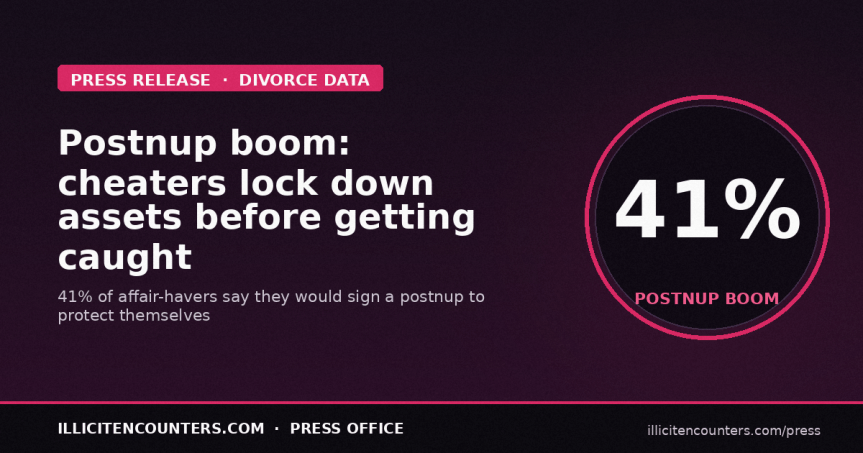
Postnup Boom: How Cheaters Are Increasingly Locking Down Assets Before Getting Caught

* 41% of people having affairs say they’d consider signing a postnuptial agreement to protect themselves if their infidelity is discovered.
* 22% have already consulted a solicitor since beginning their affair — citing fear of divorce fallout, revenge, or loss of children’s inheritance.
* High-earning professionals like lawyers, surgeons, and tech entrepreneurs are leading the surge in postnups as strategic pre-divorce safeguards.
* Study conducted by IllicitEncounters.com, the UK’s largest extramarital dating site.

A growing number of unfaithful Brits are quietly protecting their wealth in case their secrets come to light. 

According to a new poll of 2,500 married members by IllicitEncounters, the UK’s leading married dating site, 41% say they would consider signing a postnuptial agreement – not as a romantic gesture, but as a financial safeguard in case their affair is discovered.

Of those considering it, 22% revealed they’ve already consulted a solicitor since starting their affair, exploring how to ringfence their assets and avoid a costly divorce. 

The motivations behind the postnup boom are striking. The majority of those surveyed – 67% – say they want to protect their wealth from being divided up in court. Another 44% say their primary concern is securing their children’s inheritance, while 31% admit they’re bracing for revenge – expecting their spouse to retaliate financially if the affair comes to light.

Certain professions are leading the charge. Lawyers were the most likely to be exploring postnups, making up 19% of those considering the move. They were followed by consultants (16%), surgeons (14%), and tech entrepreneurs (12%) – all high-pressure, high-income roles where reputation and financial stability are often tightly intertwined.

Jessica Leoni, sex and relationships expert at IllicitEncounters, says the data points to a major shift in how modern affairs are playing out. “This isn’t just a legal trend – it’s a warning sign,” she said. “Affairs are no longer just emotional or sexual gambles. They’re strategic risks – and people are planning for the consequences before they even get caught. 

Postnups used to be rare, even taboo. But now they’re part of the cheater’s toolkit. Love may be unpredictable, but divorce can be expensive – and for many, protecting their wealth comes before protecting their marriage.”

One anonymous member put it bluntly: “If I get caught, I’ll lose my house and half my business. A postnup won’t protect my relationship – but it might just protect everything else.”

As extramarital relationships become more common among ambitious professionals, the rise in postnuptial agreements suggests that even betrayal now comes with a back-up plan.

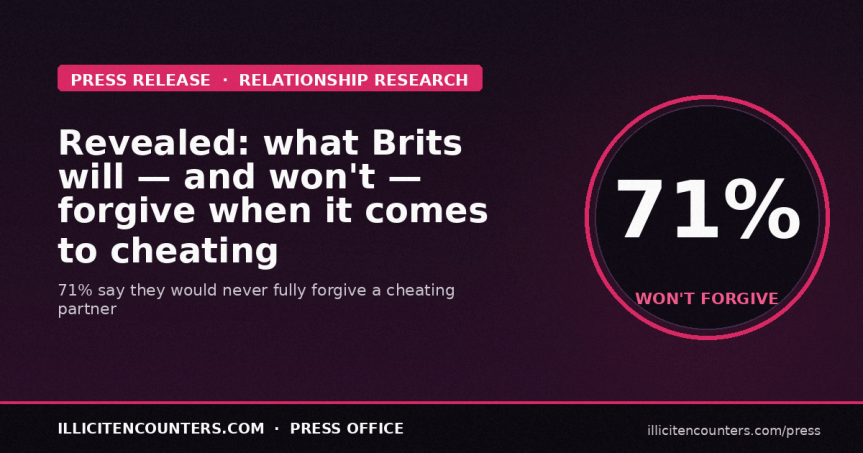
Revealed: What Brits Will – and Won’t – Forgive When It Comes to Cheating

* 71% of Brits say they would never fully forgive a partner for cheating.

* Only 12% believe a relationship can recover completely after infidelity.

* A drunken kiss is the most forgivable form of betrayal, with 89% saying they could overlook it.

* Poll conducted by IllicitEncounters.com, the UK’s leading married dating site.

Can someone who cheats on their partner ever be trusted again? That’s the question at the heart of Netflix’s Cheat: Unfinished Business, which reunites eight ex-couples torn apart by infidelity to see if forgiveness – and even love – can be salvaged. But a new poll suggests the odds aren’t good.

A new poll involving 2,500 people (split evenly between men and women) by IllicitEncounters.com, the UK’s leading married dating site, has revealed that 71% of its members would end their relationship immediately if their partner was unfaithful. 

Despite their own involvement in affairs, only 12% of respondents said they believed couples can “fully recover” from cheating once the trust has been broken. Interestingly, the poll found that men were slightly more open to reconciliation than women: 38% of male respondents said they had previously forgiven a cheating partner and stayed together, compared to just 17% of women.

When it came to what kind of cheating people might actually forgive, the results were striking. A drunken kiss was seen as the most forgivable form of betrayal, with 89% saying they could potentially overlook it. Sexting followed at 66%, while just over half (51%) saying they could move past a partner secretly using dating apps. 

More subtle betrayals – like “micro-cheating” (flirty messaging, liking provocative posts, or maintaining ambiguous friendships) – were forgivable for 39%. But forgiveness dropped off sharply when it came to physical or emotional intimacy: only 23% said they could get over a one-night stand, and just 17% said the same for emotional cheating. Full sexual intimacy saw forgiveness plummet to just 9%, while paying for sex was seen as the most unacceptable breach – with only 3% saying they could ever look past it.

The idea of revenge after betrayal proved to be a divisive topic, with one in four people (24%) admitting they would consider “cheating back” if they found out their partner had strayed. 

The results also show a generational divide: Gen Z were the most likely to forgive infidelity (39%), followed by Baby Boomers (25%), Gen X (19%) and Millennials (17%). 

Geography played a role too – the Welsh were revealed as the least forgiving nation (36%), while the Scots topped the charts for being open to giving cheaters another shot (55%).

Jessica Leoni, spokesperson for IllicitEncounters.com, said: “You might expect our members to be more open-minded about infidelity – but the opposite is true. What this poll shows is that even among people who stray, betrayal cuts deep. Trust is complex, and once broken, it’s rarely rebuilt. Netflix’s Cheat: Unfinished Business tackles exactly this issue – and our results show just how unlikely it is for couples to come back from that kind of rupture.”

Types of infidelity people are most likely to forgive:
Drunken kiss – 89%
Sexting – 66%
Secret use of dating apps – 51%
Micro-cheating – 39%
One-night-stand – 23%
Emotional cheating – 17%
Sexual intimacy – 9%
Paying for sex – 3%

Ages most likely to forgive infidelity
Gen Z – 39%
Baby Boomers – 25%
Gen X – 19%
Millennials – 17%

Country most likely to forgive infidelity
Scotland – 45%
England – 27%
Northern Ireland – 18%
Wales – 10%

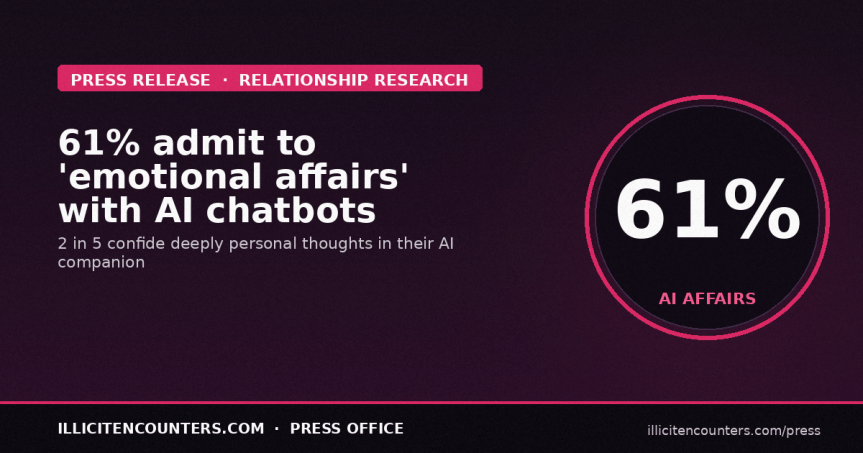
AI Chatbots Are Causing a Surge in ‘Emotional Cheating’ Among Couples, study reveals

* 61% of respondents admitted to engaging in emotional affairs with AI chatbots in the past year.

* 2 in 5 people confess to having disclosed deeply personal thoughts and emotions to their AI companions – things they had never shared with their real-life partners.

* Experts warn that reliance on AI for emotional support may create distance in real-life relationships.
* Study conducted by IllicitEncounters.com, the UK’s largest extramarital dating site.

A recent study conducted by extramarital affairs site IllicitEncounters.com has shed light on an emerging trend in modern relationships: emotional cheating through the use of AI bots. 

The poll, which surveyed 2,000 members – an equal split of men and women – revealed that a staggering 61% had used an AI chatbot to engage in an emotional affair over the past year.

One of the most striking findings of the survey was that over half (56%) of respondents admitted to sharing intimate details and personal struggles in their relationships with their AI companions. For many, these chatbots provided a judgement-free space to express frustrations, fears, and unmet emotional needs.

Even more concerning, nearly 2 in 5 (41%) of participants confessed to disclosing deeply personal thoughts and emotions to their AI companions – things they had never shared with their real-life partners. This suggests that many people find AI chatbots to be safer and more understanding than their human counterparts.

The study also revealed that 1 in 4 (26%) users reported forming a strong emotional bond with their AI chatbot. Unlike traditional forms of infidelity, which often involve a physical connection, emotional cheating with AI exists purely in the digital realm. Yet, for those involved, the connection feels real and significant.

Interestingly, despite the deep emotional ties being formed, 81% of respondents who admitted to having an emotional affair with AI stated that they felt no guilt about their chatbot relationships – not considering them to be “real” cheating. 

One person who took part in the study, identified only as “Janice,” shared her experience of forming a deep emotional bond with an AI chatbot. “At first, it was just casual chatting which began out of curiosity, but over time, I found myself turning to the AI more than my husband when I was feeling stressed or alone. It never judges me, always listens, and provides comfort in a way that my partner doesn’t always understand. I know it’s not a real person, but the connection feels real, and that’s what matters to me.”

Jessica Leoni, a sex and relationships expert at IllicitEncounters.com, weighed in on the phenomenon, noting that AI chatbots are providing emotional support in ways that some partners fail to. “The rise of AI chatbots as emotional companions suggests that many people feel unheard or unfulfilled in their relationships. While these chatbots can serve as a temporary emotional crutch, they could also deepen the divide between partners instead of encouraging open and honest communication.”

Leoni also warned that relying on AI for emotional intimacy could pose long-term risks. “While it may seem harmless at first, forming an attachment to an AI chatbot could lead to emotional distance from real-life partners, making it harder to address underlying issues in the relationship.”

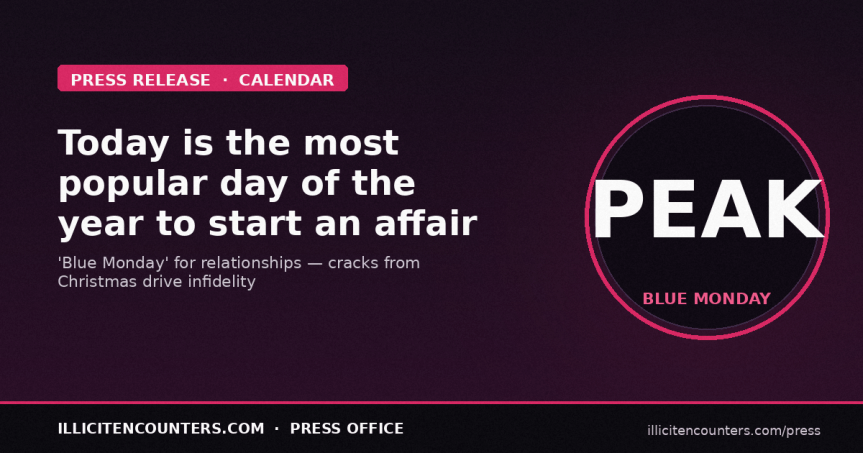
People are more likely to start having an affair today than any other time of the year

* Dubbed ‘Blue Monday’ for relationships, the 6th January is the day that people turn to infidelity as a result of cracks revealed during the festive period.

* Registrations on married dating site IllicitEncounters.com are forecast to be up 33% compared to the same time last year, with the website struggling to keep up with the ‘unprecedented demand’.

* 37% of people who have joined the website since the start of 2025 say they did so in search of physical intimacy, 29% seek the thrill and excitement of an affair, and 21% are looking for emotional support.

* Survey conducted by IllicitEncounters.com, the UK’s largest extramarital dating site.

Today is the day that people are most likely to have an affair. The 6th January, dubbed ‘Blue Monday’ for relationships, shares the spotlight with Divorce Day, as both land on the first working Monday of the year. 

Relationship experts warn that more people are likely to start having an affair today than any other time of the year, driven by post-holiday blues and a desire for a fresh start.

Leading affairs site, IllicitEncounters.com, has reported a staggering 33% increase in new member registrations compared to this time last year, with the trend expected to climb further as the week progresses. 

The website, which caters to those seeking discreet extramarital connections, has been overwhelmed by the influx. “It’s the busiest we’ve ever been. The start of a new year always prompts a spike, but 2025 has started off with unprecedented demand – in fact, we’ve admittedly been struggling to keep up with the surge in sign-ups, but we’ve got a team working around the clock to keep things running smoothly.” said IllicitEncounters.com spokesperson, Jessica Leoni.

To gain insight into the motivations driving this surge, the site conducted a poll of 500 newly registered members. Physical intimacy emerged as the top reason, cited by 37% of respondents, while 29% admitted to seeking the thrill and excitement of an affair. Meanwhile, 21% said they were looking for emotional support, a void left unfilled in their current relationships. A smaller percentage (5%) joined as an act of revenge after discovering their partner’s infidelity.

Kathy*, 38 from Brighton who joined the platform on New Year’s Day, shared her perspective, describing how she felt disillusioned after years of feeling invisible in her marriage. “It wasn’t an impulsive decision. I’ve been unhappy for a long time, and after the Christmas holidays, I realised I couldn’t keep pretending everything was fine,” she said. “I joined hoping to find someone who sees me, someone who brings joy back into my life. It’s not just about physical intimacy – although that’s important – it’s also about feeling wanted and valued again.”

According to IllicitEncounters.com’s spokesperson, Jessica Leoni, “The post-holiday period often exacerbates relationship tensions. People spend weeks in close quarters during the festive season, which can highlight existing cracks. January feels like a fresh start, and for some, that means exploring new connections, even outside their relationship.”

*Name has been changed.

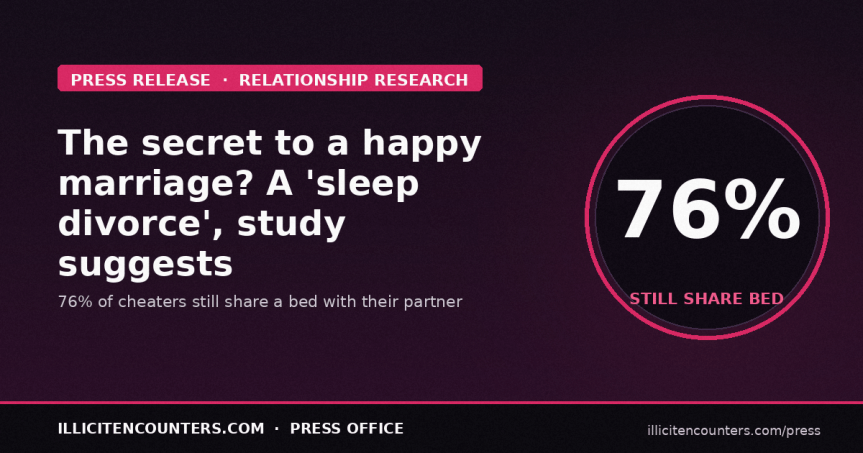
The secret to a happy marriage? Study reveals it’s a ‘sleep divorce’

* 76% of people who admitted to cheating on their partner revealed they still share the same bed with them, suggesting the secret to marital bliss is actually a ‘sleep divorce’.

* Sexpert Jessica Leoni revealed that sleeping in the same bed as your spouse can lead to tension in a relationship, but many fear that staying in separate bedrooms is a sign of failure.

* Study conducted by IllicitEncounters.com, the UK’s largest extramarital dating site.

In a shocking new study, it seems the key to a long-lasting and happy marriage may not lie in romantic getaways or date nights, but in something far more unexpected – sleeping apart. 

The poll by IllicitEncounters.com, which surveyed 2,000 people (1,000 men and 1,000 women), has uncovered a growing trend among couples who are saying goodbye to the traditional shared bed and embracing a ‘sleep divorce’.

According to the findings, a staggering 76% of people who admitted to cheating on their partner are still sharing the same bed. In contrast, only 24% of those who cheat sleep in separate bedrooms. The numbers have sparked debate over whether sleeping together could be driving couples apart rather than bringing them closer.

A ‘sleep divorce’ isn’t as dramatic as it sounds. In fact, it’s a growing trend where couples intentionally choose to sleep apart to preserve their relationship. Far from being a sign of trouble, many couples who opt for sleep divorces say it actually strengthens their bond by removing the irritations that come with sharing a bed – like snoring, restless nights, or mismatched sleep patterns.

While the idea might seem unromantic, it’s becoming increasingly popular, even among celebrities. Stars like Bette Midler and Joe Swash have gone public about sleeping separately from their partners, praising the arrangement for the positive impact it’s had on their relationships. Whilst Cat Deeley and Patrick Kielty also revealed they sleep in separate bedrooms, prioritising sleep quality and personal space to keep their relationship strong.

Jessica Leoni, a sex and relationships expert at IllicitEncounters.com, explained that many couples are increasingly realising that sharing a bed might be more of a habit than a necessity. “Many couples feel like they should share a bed because that’s what’s expected,” Leoni says. “But if one partner is tossing and turning or there’s emotional distance between them, it can make things worse. A ‘sleep divorce’ can sometimes reduce that tension, giving couples space to sleep better and reconnect.”

But what about couples who continue to share a bed despite being in an unhappy relationship? The study revealed a significant number of these individuals are cheating on their partners – yet they still choose to sleep in the same bed.

One participant in the poll, Sarah, confessed that even though she’d been unfaithful for over a year, she still shares the same bed with her husband. “It’s complicated,” she admitted. “On the surface, everything looks fine. We’ve got kids, a house, and a routine. But it’s all a facade. The truth is, we’re both miserable, but neither of us wants to admit it. 

Sharing a bed feels like one of the last things we’re holding onto, even though it’s really only for appearances. I’m cheating because I feel emotionally disconnected, but I guess we sleep together because we’re both too afraid of the alternative – it would make it all too real.”

Leoni believes that cases like Sarah’s are more common than people think. “Cheating often happens because one partner feels unfulfilled,” she explains. “But instead of addressing the root issue, many couples stay stuck in old patterns, like sharing a bed, to maintain the image of a ‘normal’ marriage. They’re afraid that sleeping separately will be seen as a sign of failure. But the truth is, a ‘sleep divorce’ could be exactly what’s needed to heal the relationship – or at least start the conversation.”