

Brits admit secretly checking their partner’s phone at least once a week – and many don’t think it’s wrong

* More than half of Brits admit snooping on their partner’s phone without permission
* Over a quarter say they check their partner’s device at least once a week
* Women are significantly more likely to snoop than men
* Study conducted by IllicitEncounters.com, the UK’s largest extramarital dating site

Smartphones may hold the secrets of our daily lives – but for many couples, they’ve also become a source of temptation.

A new poll of 2,500 people conducted by IllicitEncounters.com, the UK’s largest extramarital dating site, has revealed that 52% of Brits admit they have secretly checked their partner’s phone without permission.

And for many, it’s not just a one-off act of curiosity. Among those who confessed to snooping, 27% admitted they check their partner’s phone at least once a week, suggesting that secret surveillance has become a regular habit in some relationships.

When asked how often they had secretly checked their partner’s phone, 12% admitted doing so every day, while 27% said they snoop at least once a week. A further 19% said they check around once a month, while 42% insisted they had only done it once or twice out of curiosity.

Despite the obvious privacy implications, many respondents didn’t feel particularly guilty about their behaviour. In fact, 34% of those who admitted snooping said they didn’t consider secretly checking their partner’s phone to be “that bad.”

For some, however, the habit has led to uncomfortable discoveries. 27% of those who checked their partner’s device said they found something upsetting, whether that was suspicious messages, conversations they felt crossed a line, or evidence of behaviour their partner had previously denied.

The research also revealed a clear gender divide when it comes to phone snooping. Women were more likely to admit checking their partner’s phone, with 58% confessing to doing so compared to 46% of men.

One woman who took part in the survey, a 35-year-old sales manager from Manchester who asked to remain anonymous, said curiosity initially drove her to look through her partner’s phone.

“It started as a gut feeling more than anything,” she says. “He’d started turning his phone face down on the table and taking it with him everywhere, even just to make a cup of tea. I told myself I was being paranoid, but the thought wouldn’t leave my head.”

Eventually, she decided to take a look while he was asleep. “I hated the idea of snooping, but at the same time I felt like I needed reassurance,” she says. “Once you’ve had that suspicion planted in your mind, it’s really hard to ignore it.”

What she found wasn’t outright evidence of cheating, but it was enough to shake her trust. “There were messages with another woman that felt a bit too friendly for my liking,” she says. “Nothing explicit, but lots of late-night chats and inside jokes. It made me feel like there was something emotional going on that I didn’t know about.”

Jessica Leoni, sex and relationships expert at IllicitEncounters.com, says the findings highlight how smartphones have become a major issue for modern relationships. “Phones contain so much of our personal lives now – messages, social media conversations, photos and browsing history,” she explains. “For someone who already feels insecure in their relationship, the temptation to look can be overwhelming.”

However, she warns that snooping can often create more problems than it solves. “Checking a partner’s phone might provide temporary reassurance, but it can also damage trust if the behaviour becomes habitual,” she says. “In many cases, it reflects deeper issues in the relationship, such as insecurity, poor communication or a lack of transparency.”

Leoni adds that once someone begins regularly checking their partner’s phone, it can quickly become a cycle that’s difficult to break. “Suspicion often feeds itself,” she says. “The more someone looks for evidence of wrongdoing, the more likely they are to interpret normal behaviour as something suspicious. Healthy relationships depend on trust – and that’s very difficult to maintain if one partner feels constantly monitored.”

Results

Have you ever secretly checked your partner’s phone without their permission?
Yes – 52% (58% women, 46% men)
No – 48% (42% women, 54% men)

How often do you check your partner’s phone? (Of those who admitted to checking without permission)
Every day – 12%
At least once a week – 27%
At least once a month – 19%
At least once a year – 42%
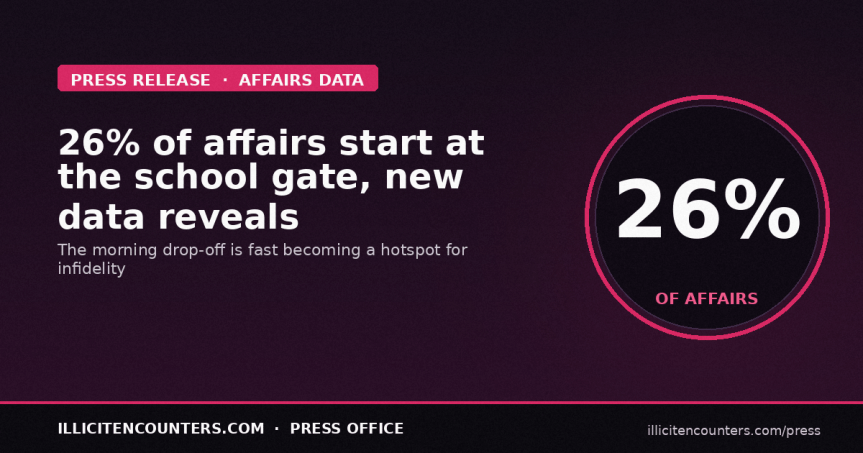

26% of affairs start at the school gate, new data reveals

* More than a quarter of affairs begin through school connections, new research shows
* Parents of children in Years 3 and 4 are most at risk, according to the data
* PTA meetings, sports days and class WhatsApp groups are the most common affair flashpoints
* Study conducted by IllicitEncounters.com, the UK’s largest extramarital dating site

It’s the place you drop off your kids every morning. But according to new research, the school gate is also one of Britain’s most fertile grounds for extramarital affairs.

A poll of 2,200 parents by IllicitEncounters.com, the UK’s leading married dating site, has revealed that 26% of affairs begin through school connections – making it one of the most common places a marriage starts to unravel.

And the danger zone? Parents of children in Years 3 and 4 are the most likely to stray, accounting for 21% of school-gate affairs. Years 1 and 2 parents follow closely at 19%, with Years 5 and 6 at 18%. Reception parents account for 16%, secondary school parents for 15%, and sixth form parents make up the remaining 11%.

As for where these connections are made, PTA meetings top the list at 31%, followed by class WhatsApp groups at 27% – proving that the group chat intended for reading lists and bake sale reminders could be doing more harm than good in relationships.

Sports days accounted for 19% of initial encounters, while the daily school pick-up and drop-off itself is responsible for 13%. School social events such as discos, fairs and fundraisers account for the remaining 7%.

Perhaps most striking of all is the speed at which these connections escalate. On average, it takes just 4.7 months from first meeting to full-blown affair – suggesting that regular contact, shared parenting experiences, and underlying marital dissatisfaction make for a potent combination.

One woman who took part in the poll, a mother of two from the South East, says her affair began ​​innocently in a Whatsapp group, “We were both in the Year 3 group, and he messaged me privately to ask if my son had brought home the wrong jumper. We started joking about how stressful the homework was, and within a month, those jokes turned into late-night chats.

The school run became the highlight of my day. We’d catch each other’s eye across the playground – it felt like we had this huge secret in plain sight. It’s the perfect cover, your spouse never suspects you’re cheating when you say you’re just staying late for a PTA meeting.”

Jessica Leoni, sex and relationships expert at IllicitEncounters.com, says the findings are unsurprising. “The school gate is a goldmine for connection – you see the same people every single day, you have an instant shared bond in your children, and you’re often at a stage of life where your marriage has settled into routine. Add a flirty WhatsApp group into the mix and it’s a recipe for something more.”

Leoni says the research highlights how everyday routines can unexpectedly create opportunities for relationships to form. “Affairs rarely begin in dramatic circumstances,” she says. “More often they start with ordinary conversations that slowly become more personal over time.”

Results

At what point in your children’s school life did your affair start?

Reception – 16%
Years 1 to 2 – 19%
Years 3 to 4 – 21%
Years 5 to 6 – 18%
Secondary school – 15%
Sixth Form/College – 11%

How did the affair begin?

PTA meetings – 31%
Class WhatsApp groups – 27%
Sports day – 19%
School pick-up/drop-off – 13%
School social events – 7%
Other – 3%

Red Tuesday: You’re more likely to be dumped today than any other time of the year, expert warns

* The Tuesday before Valentine’s Day is the most popular time for people to get dumped.
* 37% of people revealed they’ve dumped their partner in the week leading up to Valentine’s Day.
* Of those, 52% admitted to ditching their partner on the Tuesday before Valentine’s Day, also known as ‘Red Tuesday’.
* The go-to method for breaking up is via WhatsApp messages (33%), followed by face-to-face dumping (21%) and breaking the news on a phone call (17%).
* Study conducted by IllicitEncounters.com, the UK’s largest extramarital dating site.

With Valentine’s Day just around the corner, it’s usually a time filled with romance and anticipation for couples. You might be expecting a fancy gift or dinner at a snazzy restaurant, but actually, new research reveals that you could fall victim to ‘Red Tuesday’ instead.

Today is the day that people are most likely to be dumped. Yes, really. 

According to a survey by IllicitEncounters.com, the UK’s largest extramarital dating site, the Tuesday before Valentine’s Day, known as ‘Red Tuesday’, could see your relationship crashing down just before the most romantic day of the year.

The website polled 1,500 of its members, and incredibly, 37% admitted to breaking up with their partner in the run up to Valentine’s Day.

Of those, a whopping 52% said they dumped their other half on ‘Red Tuesday’.

45% revealed that they dumped their partner in the week leading up to the most romantic day of the year, and 5% had the guts to end their relationship on Valentine’s Day itself!

So, what’s the most popular method when it comes to throwing in the towel? 33% of people went down the WhatsApp message route, whilst 21% mustered up the courage to break the bad news face-to-face. 8% didn’t even bother letting their partner know the relationship was over, and simply ghosted them – ouch!

Jessica Leoni, sex and relationships expert and spokesperson at IllicitEncounters.com, commented on the ‘Red Tuesday’ phenomenon, saying, “It’s a bit of a “V-Day pressure cooker” situation. As we get closer to the day of romance and roses, there’s this expectation to have this epic, Instagram-worthy love story. Suddenly, people find themselves questioning if their current relationship is measuring up to the grand gestures they see all over social media.

And let’s not forget the gift-giving stress that comes with celebrating Valentine’s Day. If one person is expecting a romantic masterpiece and ends up with a last-minute box of chocolates, it can lead to some serious disappointment.”

Leoni even suggested that people don’t give into the hype of Valentine’s Day, saying “I actually recommend that couples AVOID celebrating Valentine’s Day if you really want your love to thrive. Don’t give in to the commercialisation of the day, because you’re just adding extra strain to relationships, especially if they’re already on unsteady ground.”

Results
Ways people have dumped their partner around Valentine’s Day

WhatsApp message 33%
Face to face 21%
Phone call 17%
Social media 14%
Ghosting 8%
Through a friend 5%
Other 2%