

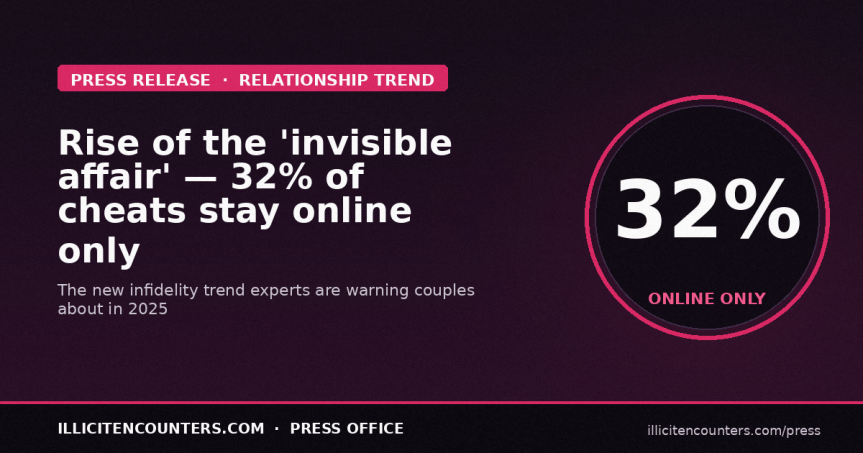
* 32% of cheaters say their most recent affair never became physical.
* ‘Invisible affairs’ take place entirely online – making them ideal for people who aren’t necessarily looking for a physical connection but feel the need to be “seen, heard and desired”.
* 78% of people having ‘invisible affairs’ say they turned to virtual relationships because of a lack of emotional connection at home.
* Study conducted by IllicitEncounters.com, the UK’s largest extramarital dating site
A new type of affair is on the rise in 2025 – and it’s one you might never see coming.
According to a new survey of 1,600 married users on IllicitEncounters.com – the UK’s leading dating site for affairs – 32% say their most recent affair never actually became physical.
Dubbed ‘invisible affairs’, these relationships are defined by the complete absence of physical contact, yet they can still spark deep emotional and sexual connections. Unlike traditional infidelity, they leave behind no telltale signs – no lipstick-stained collars, no unexplained receipts, and no need for physical cover stories. For many, this is the exact appeal: discretion, safety, and emotional intimacy without the risk of being caught in the real world.
The ways in which people are conducting these affairs are varied, but all remain digital. The majority – 74% – said they maintain their virtual relationships through regular phone calls, while 65% admitted to exchanging flirty messages or sexting. Nearly half – 47% – send intimate photos and videos, and 26% have engaged in virtual sex via video calls.
So what’s behind the rise of invisible affairs? Emotional dissatisfaction seems to be the biggest driving force. A striking 78% of those engaged in these virtual relationships said they were seeking emotional support they felt was missing in their current relationship.
Meanwhile, 67% reported feeling less guilt because there was no physical cheating involved, and 61% said they preferred this type of affair simply because it’s easier to hide. Another 43% admitted they were attracted to the thrill and excitement of digital intimacy, while 38% said they wanted to maintain physical loyalty to their spouse.
One anonymous member, a 42-year-old accountant from Surrey, described how her virtual relationship developed with a man she met on IllicitEncounters.com. “We’ve never met in person – but we talk every night. It started as innocent flirting, and it’s developed into one of the most emotionally intense relationships I’ve ever had. I’ve always felt invisible in my marriage and I increasingly got the sense that my husband just wasn’t interested in anything I had to say or how I felt. Keeping my affair online doesn’t feel like I’m cheating on my husband in the traditional sense, and I don’t think I’ll stop any time soon.”
Jessica Leoni, sex and relationships expert and spokesperson for IllicitEncounters.com, says the shift reflects how digital intimacy is redefining modern relationships. “Invisible affairs aren’t about avoiding connection – they’re about creating it in a new way,” she explains. “For many, these relationships offer a much-needed sense of being seen, heard, and desired, especially when that’s lacking at home.”
She adds: “They may not involve meeting in person, but the feelings involved can be just as powerful. These kinds of affairs highlight how modern infidelity is evolving – and how emotional needs often come before physical ones.”
Results
How are cheaters maintaining ‘invisible affairs’?
Phone calls 74%
Flirty messages/sexting 65%
Sending intimate photos/videos 47%
Virtual sex via video calls 26%
Why are people turning to ‘invisible affairs’?
Emotional unfulfillment in primary relationship 78%
Feel less guilty 67%
Thrill and excitement 61%
Want to maintain physical loyalty to partner 43%
 Press & Media | Illicit Encounters – UK's #1 Married Dating Site